
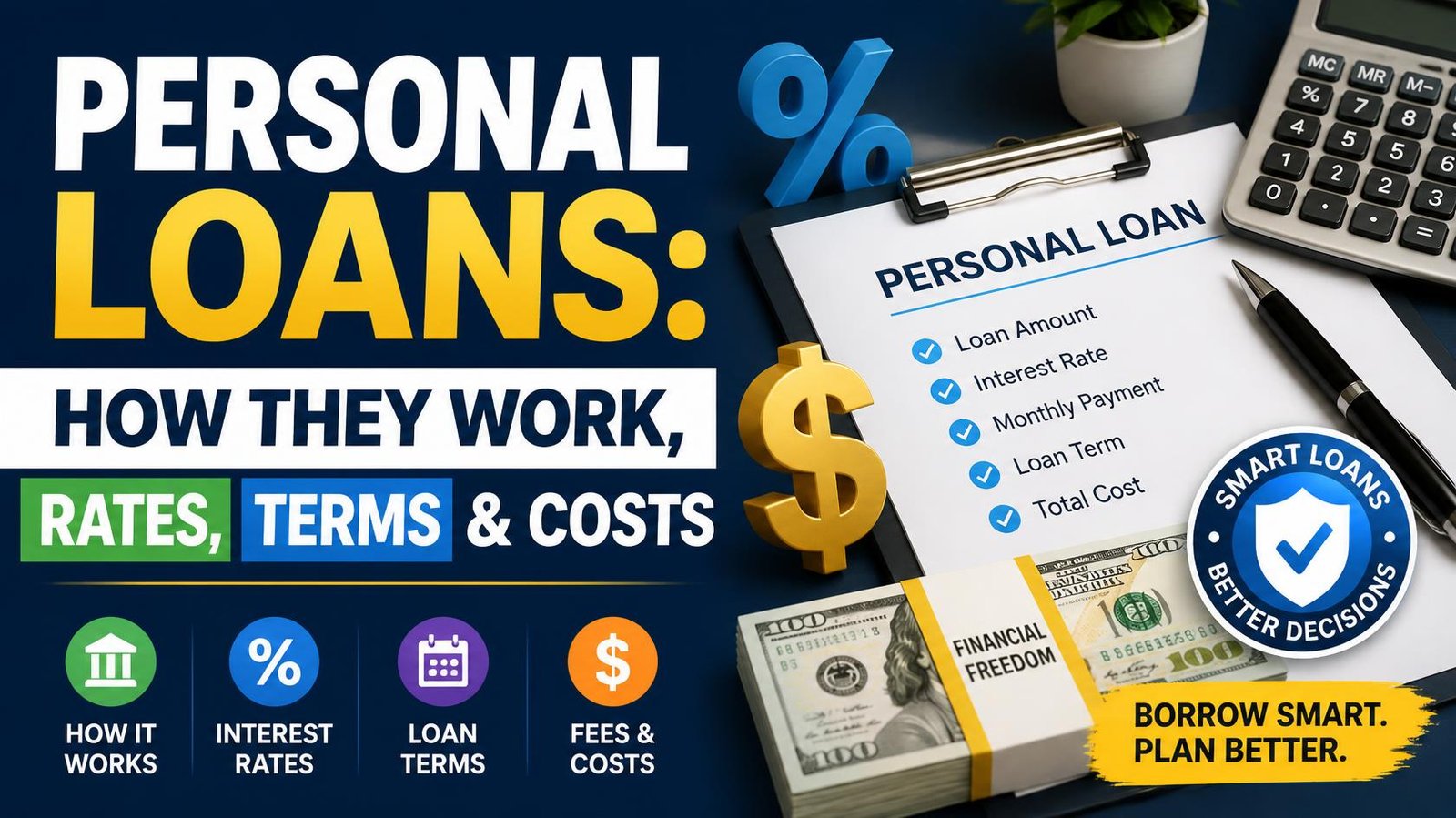
A personal loan can turn one large expense into a series of predictable monthly payments. That can be useful when you need to cover a major expense, consolidate certain debts, or handle an unexpected financial need.
But there is an important part that is easy to overlook: the amount you receive is not necessarily the amount a personal loan will ultimately cost you.
Interest, loan term, origination fees, late fees, and other charges can change the total price significantly. A loan with a lower monthly payment may even cost more overall if you take longer to repay it.
So before looking for the “best personal loan,” it helps to understand exactly how personal loans work, how lenders determine rates, what loan terms mean, and which costs deserve the most attention.
This guide explains personal loans in straightforward terms so you can compare borrowing options more confidently.
What Is a Personal Loan?
A personal loan is money borrowed from a bank, credit union, or other lender that you agree to repay over a specified period.
Most personal loans are installment loans. Instead of borrowing repeatedly from an available credit line, you generally receive a specific amount and repay it through scheduled payments.
The Consumer Financial Protection Bureau describes a personal installment loan as a loan in which the borrower receives money upfront and repays it in fixed installments over a specific period. Personal installment loans can be used for purposes such as large purchases, unexpected expenses, or debt consolidation.
For example, suppose a lender approves a $10,000 personal loan with a five-year repayment period. You would generally make scheduled payments during those five years until the loan balance and applicable interest and fees are paid.
The actual payment depends on factors such as:
- Loan amount
- Interest rate
- APR
- Repayment term
- Fees
- Lender requirements
- Borrower’s credit and financial profile
How Do Personal Loans Work?
The basic process is fairly simple.
You apply for a specific amount, the lender evaluates your application, and—if approved—the lender provides the funds according to the loan agreement.
You then repay the loan over the agreed term.
A typical personal loan process looks like this:
1. Determine how much you need
Start with the actual amount required rather than automatically borrowing the maximum offered by a lender.
2. Compare lenders
Different lenders may offer different rates, fees, loan amounts, and repayment periods. Comparing multiple offers can help you understand your available choices.
3. Review eligibility
Lenders may consider your credit history, income, existing debts, requested loan amount, repayment term, and other information when determining whether to approve the loan and what terms to offer.
4. Review the offer
If approved, examine the interest rate, APR, monthly payment, repayment term, fees, and total repayment amount.
5. Accept the loan
If the terms fit your financial situation, you can accept the agreement according to the lender’s process.
6. Receive the funds
Once the loan is finalized, the money is generally sent to your bank account or, in some situations, directly toward a creditor or other approved purpose.
7. Make scheduled payments
You repay the loan according to the payment schedule until the balance is paid off.
The exact process varies between lenders, so the loan agreement is the final source for your specific terms.
What Are Personal Loan Rates?
A personal loan rate is the interest rate a lender charges for allowing you to borrow money.
The rate is one of the most important factors affecting the cost of a personal loan.
Generally, a lower interest rate means less interest paid over the same repayment period, assuming the other loan terms are comparable.
But the advertised interest rate alone does not tell you everything.
That’s where APR becomes important.
Personal Loan Interest Rate vs. APR
Interest rate and APR are related, but they are not always the same thing.
Interest rate
The interest rate represents the percentage used to calculate the interest charged on the amount you borrow.
APR
The annual percentage rate can provide a broader measure of borrowing cost because it can incorporate certain fees and charges associated with obtaining credit.
For this reason, borrowers should look beyond a headline interest rate when comparing personal loan offers.
A loan advertising a low interest rate may not necessarily be the least expensive option if it includes significant fees.
A simple example
Imagine two lenders offer similar personal loans.
Lender A
- Lower interest rate
- Higher upfront fee
Lender B
- Slightly higher interest rate
- Little or no upfront fee
The first lender may look cheaper when you only compare the interest rate. Once fees are included, the second loan could potentially have a lower overall cost.
That is why comparing the complete loan offer is more useful than comparing one number.
What Determines Personal Loan Rates?
There is no single personal loan rate that applies to every borrower.
Lenders generally evaluate the risk and cost associated with making the loan.
Factors can include:
Credit score and credit history
Your credit history can influence how a lender evaluates your application and what rate or terms you may receive.
A stronger credit profile can improve your chances of receiving more favorable terms, although approval and pricing policies vary by lender.
Income
Lenders may review income to determine whether the requested payment appears manageable based on the information in your application.
Existing debt
Your current obligations can affect how a lender evaluates your ability to repay additional debt.
Loan amount
The amount you request can influence the terms offered by a lender.
Repayment term
The length of the loan can affect both the monthly payment and the total amount of interest paid.
Broader interest-rate conditions
Lenders’ funding costs and broader market conditions can influence consumer borrowing rates. The Federal Reserve Bank of Minneapolis explains that consumer interest rates can reflect funding costs, risk, operating costs, market conditions, and other factors.
This is one reason personal loan rates can change over time.
What Are Personal Loan Terms?
The loan term is the amount of time you have to repay the loan.
For example, a personal loan could have a repayment period of several years, depending on the lender and product.
The term matters because it affects your monthly payment and total interest cost.
Shorter loan term
A shorter term usually means:
- Higher monthly payments
- Less time paying interest
- Potentially lower total interest cost
Longer loan term
A longer term usually means:
- Lower monthly payments
- More time to repay the balance
- Potentially higher total interest cost
This creates an important trade-off.
A longer repayment period can make a loan easier to fit into a monthly budget, but it may increase the total cost of borrowing.
Never judge a personal loan solely by its monthly payment.
Look at the total amount you will repay.
How Much Does a Personal Loan Cost?
The total cost of a personal loan can include more than interest.
Depending on the lender and loan, possible costs may include:
- Interest
- Origination fees
- Documentation or processing fees
- Late payment fees
- Returned-payment fees
- Other charges specified in the loan agreement
The CFPB specifically notes that personal installment loans can include fees such as origination fees, documentation fees and late fees.
Some optional products or insurance-related charges may also appear in certain loan arrangements, so borrowers should carefully review the disclosures before accepting an offer.
What Is an Origination Fee?
An origination fee is a charge a lender may apply for processing and originating the loan.
For example, imagine you are approved for a $10,000 loan and the lender charges a 3% origination fee.
The fee would be:
$10,000 × 3% = $300
If that fee is deducted from the loan proceeds, you could receive $9,700 even though the loan’s stated principal is $10,000.
This distinction matters if you need a specific amount of money in your bank account.
Always check whether fees are deducted from the proceeds or paid separately.
Personal Loan Example: How the Numbers Work
Suppose you borrow $10,000.
Your loan has:
- A fixed interest rate
- A five-year repayment term
- A monthly payment determined by the lender
- An origination fee
The monthly payment isn’t simply:
$10,000 ÷ 60
because interest and applicable charges also affect the repayment amount.
With an installment loan, each scheduled payment generally goes toward the outstanding balance and interest according to the lender’s amortization schedule.
At the beginning of the loan, a larger portion of each payment may go toward interest. As the balance decreases, the interest portion generally declines.
The exact payment and total interest depend on the actual rate, term, fees, and loan structure.
Why this matters
Two people could borrow the same amount but pay different total costs because they received different rates or selected different repayment terms.
That’s why “How much can I borrow?” is only one part of the personal-loan decision.
The better question is:
How much will this loan cost me from start to finish?
Are Personal Loans Secured or Unsecured?
Personal loans can be structured as either unsecured or secured, although many personal loans are unsecured.
Unsecured personal loans
An unsecured personal loan generally does not require you to pledge a specific asset such as a vehicle or home as collateral.
Because the lender does not have that collateral securing the loan, the lender’s assessment of your creditworthiness and ability to repay can be especially important.
The FTC notes that most personal loans are unsecured and that unsecured loans typically have higher interest rates than secured loans.
Secured personal loans
A secured loan is backed by collateral.
If the borrower fails to meet the loan agreement, the lender may have rights related to that collateral under the applicable agreement and law.
Because secured and unsecured loans work differently, compare not only the rate but also what you are putting at risk.
What Can You Use a Personal Loan For?
Personal loans can be used for different legitimate personal expenses, depending on the lender’s rules.
Common purposes may include:
- Debt consolidation
- Unexpected expenses
- Home improvements
- Major purchases
- Moving expenses
- Certain medical expenses
- Large planned expenses
The CFPB lists large purchases, unexpected expenses, and debt consolidation among potential uses for personal installment loans.
Not every lender permits every use, so check the lender’s restrictions before applying.
Personal Loans for Debt Consolidation
Debt consolidation is one of the reasons consumers may consider personal loans.
The basic idea is to use a new loan to pay off multiple existing debts, potentially leaving you with one monthly payment instead of several.
But consolidation does not automatically make debt cheaper.
For example, a borrower might reduce the monthly payment by extending the repayment period while increasing the total amount paid over time.
Before consolidating debt, compare:
- Existing interest rates
- New loan APR
- Origination fees
- New monthly payment
- New repayment period
- Total amount to be repaid
The goal should not simply be to obtain a lower monthly payment.
The goal is to understand whether the new arrangement actually improves your overall financial position.
How Credit Scores Affect Personal Loans
Your credit profile can play an important role in personal loan approval and pricing.
Lenders may review your credit reports and other financial information when evaluating an application.
A stronger credit profile can sometimes result in more favorable borrowing terms, while a weaker credit profile may result in higher costs or fewer available options.
Before applying, consider checking your credit reports for inaccurate information.
The FTC has previously advised consumers considering personal loans to check their credit reports because errors could affect credit scores and borrowing costs.
Also remember that credit-score requirements are not universal.
One lender may evaluate an application differently from another.
How to Compare Personal Loans
Comparing personal loans is easier when you use the same checklist for every lender.
Look at these factors side by side:
| Factor | What to Check |
|---|---|
| APR | Overall borrowing cost represented by the APR |
| Interest rate | Rate charged on the loan |
| Loan amount | Minimum and maximum available |
| Loan term | How long you have to repay |
| Monthly payment | Required scheduled payment |
| Origination fee | Upfront cost, if applicable |
| Late fee | Cost of missing or making a late payment |
| Prepayment terms | Whether paying early creates a charge |
| Funding time | How quickly funds may be available |
| Eligibility | Credit and income requirements |
| Total repayment | Amount you expect to pay over the life of the loan |
The CFPB recommends comparing offers from multiple lenders and reviewing fees and loan disclosures before agreeing to a personal installment loan.
Don’t compare monthly payments alone
This is one of the most common mistakes borrowers can make.
Consider two hypothetical offers:
Loan A
- Higher monthly payment
- Shorter term
- Lower total interest
Loan B
- Lower monthly payment
- Longer term
- Higher total interest
Loan B may feel more affordable every month, but Loan A could cost less overall.
The right choice depends on both affordability and total borrowing cost.
What Does Prequalification Mean?
Some lenders allow borrowers to prequalify before submitting a full application.
Prequalification can give you an idea of whether you may qualify and what terms might be available.
But prequalification is not the same as final approval.
The lender may still need additional information and may perform further checks before providing a final offer.
If multiple lenders allow you to compare potential offers before committing, that can make shopping for a personal loan more efficient.
Always read the lender’s explanation of whether the initial rate check involves a soft or hard credit inquiry.
Does Applying for a Personal Loan Affect Your Credit?
It can.
The effect depends partly on how the lender checks your credit.
Some lenders may allow an initial rate check or prequalification without the same type of credit inquiry used for a final application. A full application may involve a hard inquiry.
Because policies vary, check the lender’s disclosure before submitting an application.
Also remember that opening a new loan creates a new credit account and adds a new debt obligation.
Making payments on time can help establish positive payment history when the lender reports to credit bureaus. On the other hand, missed payments can hurt your credit.
The CFPB warns that missed personal-loan payments can have a significant effect on credit reports and scores.
What Happens If You Miss a Personal Loan Payment?
Missing a payment can create several problems.
Depending on the loan agreement and applicable law, you could face:
- Late fees
- Additional interest or charges
- Negative credit reporting
- Collection activity
- Increased financial pressure
If you know you may not be able to make a payment, contact the lender as soon as possible.
The CFPB notes that borrowers who cannot make a payment should contact their lender to discuss possible options, which may include payment arrangements or other forms of assistance depending on the situation.
The important point is not to ignore the problem.
Can You Pay Off a Personal Loan Early?
Some borrowers choose to pay off a personal loan early to reduce future interest costs.
Whether there is a fee for early repayment depends on the loan agreement and applicable rules.
Before making an extra payment or paying off the entire balance, check your contract for any prepayment-related charges and confirm how the lender applies additional payments.
If there is no penalty and your finances allow it, paying principal down faster can potentially reduce the amount of future interest you pay.
But using all of your available cash to pay off a loan may not always be the best financial decision.
Keep enough money available for necessary expenses and emergencies.
Personal Loans vs. Credit Cards
Personal loans and credit cards both allow consumers to borrow money, but they work differently.
Personal loan
- Usually provides a fixed amount upfront
- Typically has scheduled installment payments
- Often has a defined repayment term
- May have a fixed rate, depending on the product
Credit card
- Generally provides a revolving line of credit
- Allows you to borrow repeatedly up to your available limit
- Minimum payments may vary
- Interest and fees depend on the card agreement
Neither option is automatically better.
The right choice depends on the amount you need, the cost of borrowing, repayment timeline, and your ability to manage the debt.
Personal Loans vs. Payday Loans
A personal installment loan should not be confused with a payday loan.
Payday loans are generally short-term, high-cost borrowing products that may be due within a few weeks. The CFPB and FTC warn that payday loans can be expensive and that repeated borrowing or rollovers can increase costs.
A traditional personal installment loan normally has a longer scheduled repayment period and structured payments.
If you are comparing a personal loan with a payday loan because you need emergency cash, pay particular attention to the total cost, repayment timeline, and whether the payment fits your budget.
How to Avoid Personal Loan Scams
Personal loan searches can attract scammers, especially when someone is urgently looking for money.
One major warning sign is a lender or supposed loan agent demanding an upfront payment in exchange for a guaranteed loan.
The FTC warns about advance-fee loan scams, in which scammers promise credit regardless of the borrower’s circumstances and then demand money before providing the supposed loan.
Be cautious if someone:
- Guarantees approval before reviewing your information
- Promises a loan regardless of credit history
- Demands money before providing the promised credit
- Uses pressure or threats to make you act quickly
- Refuses to clearly disclose fees
- Asks for unusual payment methods
- Contacts you unexpectedly and demands immediate payment
A legitimate lender can charge legitimate application or other fees in some circumstances, so the issue is not simply whether a fee exists.
The major warning sign is a promise that paying a fee guarantees approval or access to a loan. The FTC specifically advises consumers not to pay for a promise of credit.
Questions to Ask Before Taking a Personal Loan
Before accepting an offer, ask:
What is the APR?
Don’t look only at the advertised interest rate.
What is the total amount I will repay?
This helps you understand the actual long-term cost.
Are there origination fees?
Find out whether the fee is deducted from the amount you receive.
What is the monthly payment?
Make sure it fits realistically within your budget.
How long is the repayment term?
A longer term can reduce monthly payments but may increase total interest.
Is the interest rate fixed?
Don’t assume every loan has the same rate structure.
Are there late-payment fees?
Know the consequences before signing.
Is there a prepayment penalty?
Check the agreement before planning to pay the loan off early.
Does the lender report payments to credit bureaus?
This can matter for your credit history.
What happens if I cannot make a payment?
Understanding hardship or payment options before a problem occurs is better than waiting until you miss a payment.
When Does a Personal Loan Make Sense?
A personal loan may make sense when:
- You understand the total cost
- The payment fits comfortably within your budget
- The loan solves a specific financial need
- You have compared multiple offers
- The repayment plan is realistic
- The borrowing cost is reasonable compared with alternatives
It may be less appropriate when you are borrowing simply to fund unnecessary spending or when the monthly payment would leave little room for essential expenses.
Borrowing can solve a short-term problem, but the monthly payment becomes a long-term obligation.
When Should You Consider Alternatives?
A personal loan isn’t the only way to cover a large expense.
Depending on your circumstances, alternatives could include:
- Using existing savings
- Negotiating a payment plan
- Comparing a credit union loan
- Using an existing credit card carefully
- Delaying a nonessential purchase
- Looking for a lower-cost financing option
The best alternative depends on the expense and your overall financial situation.
Don’t take a personal loan simply because the application process is convenient
A Simple Personal Loan Cost Checklist
Before signing, write down these numbers:
Amount borrowed: $________
APR: ________%
Interest rate: ________%
Loan term: ________ months
Monthly payment: $________
Origination fee: $________
Other fees: $________
Total repayment: $________
Then ask yourself one question:
Can I comfortably make this payment for the entire repayment period?
If the answer is uncertain, borrowing less, choosing a different term, or considering another financing option may be worth exploring.
Personal Loan Mistakes to Avoid
1. Choosing the loan with the lowest advertised rate
The lowest headline rate does not necessarily mean the lowest total cost.
2. Focusing only on the monthly payment
A smaller payment can come with a longer term and greater total interest.
3. Ignoring fees
Origination and other charges can materially affect the cost of borrowing.
4. Borrowing more than necessary
A lender approving a larger amount does not mean you need to borrow that much.
5. Applying without checking your credit
Reviewing your credit information beforehand can help you identify potential issues.
6. Skipping the loan agreement
Never rely solely on an advertisement or sales representative’s explanation.
Read the actual loan documents.
7. Falling for guaranteed-loan promises
Guaranteed approval combined with an upfront payment demand is a major warning sign of a potential scam.
Frequently Asked Questions About Personal Loans
A personal loan is money borrowed from a lender that is repaid over a specified period, usually through scheduled installment payments. Personal installment loans may be used for expenses such as large purchases, unexpected costs, or debt consolidation.
You apply for a specific amount, the lender evaluates your financial information, and if approved, you receive the funds according to the agreement. You then make scheduled payments until the loan is repaid.
Lenders may consider factors such as credit history, income, existing debts, loan amount, repayment term, and broader market and funding conditions.
The interest rate represents the rate charged on the borrowed balance. APR provides a broader representation of borrowing cost and can incorporate certain fees associated with obtaining credit.
The cost varies significantly between lenders and borrowers. Interest rates, loan terms, origination fees, and other charges all affect the total cost.
They can. Common fees may include origination fees, documentation fees, late fees, and other charges specified in the loan agreement.
Some lenders work with borrowers who have less-than-perfect credit, but eligibility and pricing vary. A lower credit score may result in higher borrowing costs or fewer available options.
Applying for a loan can involve a credit inquiry, depending on the lender and application stage. Once the loan is opened, payment history can also affect your credit profile. Missed payments can negatively affect your credit.
You may be able to, but check your loan agreement for any prepayment-related charges or conditions before paying it off early.
Neither is automatically better. Compare the APR, fees, repayment structure, payment amount, and total cost based on your specific situation.
Compare APR, interest rate, loan amount, repayment term, monthly payment, origination fees, late fees, prepayment terms, and total repayment amount.
Many legitimate lenders offer personal loans online, but borrowers should verify the lender and carefully review the loan agreement. Be especially cautious about anyone promising guaranteed approval in exchange for an upfront payment.
One of the biggest mistakes is focusing only on the monthly payment instead of considering the APR, fees, repayment period, and total amount you will repay.
Final Takeaway
A personal loan is not simply a way to get money today. It is a financial commitment that can continue for months or years.
The smartest way to evaluate a personal loan is to look beyond the amount you can borrow.
Compare the APR, interest rate, repayment term, monthly payment, fees, and total repayment cost. Check your credit information, compare multiple lenders, and make sure the payment fits comfortably into your budget.
Most importantly, don’t let a low monthly payment or a quick approval distract you from the total cost.
A personal loan can be useful when the borrowing is affordable and the purpose makes sense. The key is understanding exactly what you are agreeing to before you sign.
Sources for further verification: Consumer Financial Protection Bureau, Federal Trade Commission, and Federal Reserve materials were used to verify the general loan mechanics, fees, rate factors, and consumer-protection information in this guide.
2 thoughts on “Personal Loans: How They Work, Rates, Terms & Costs”