
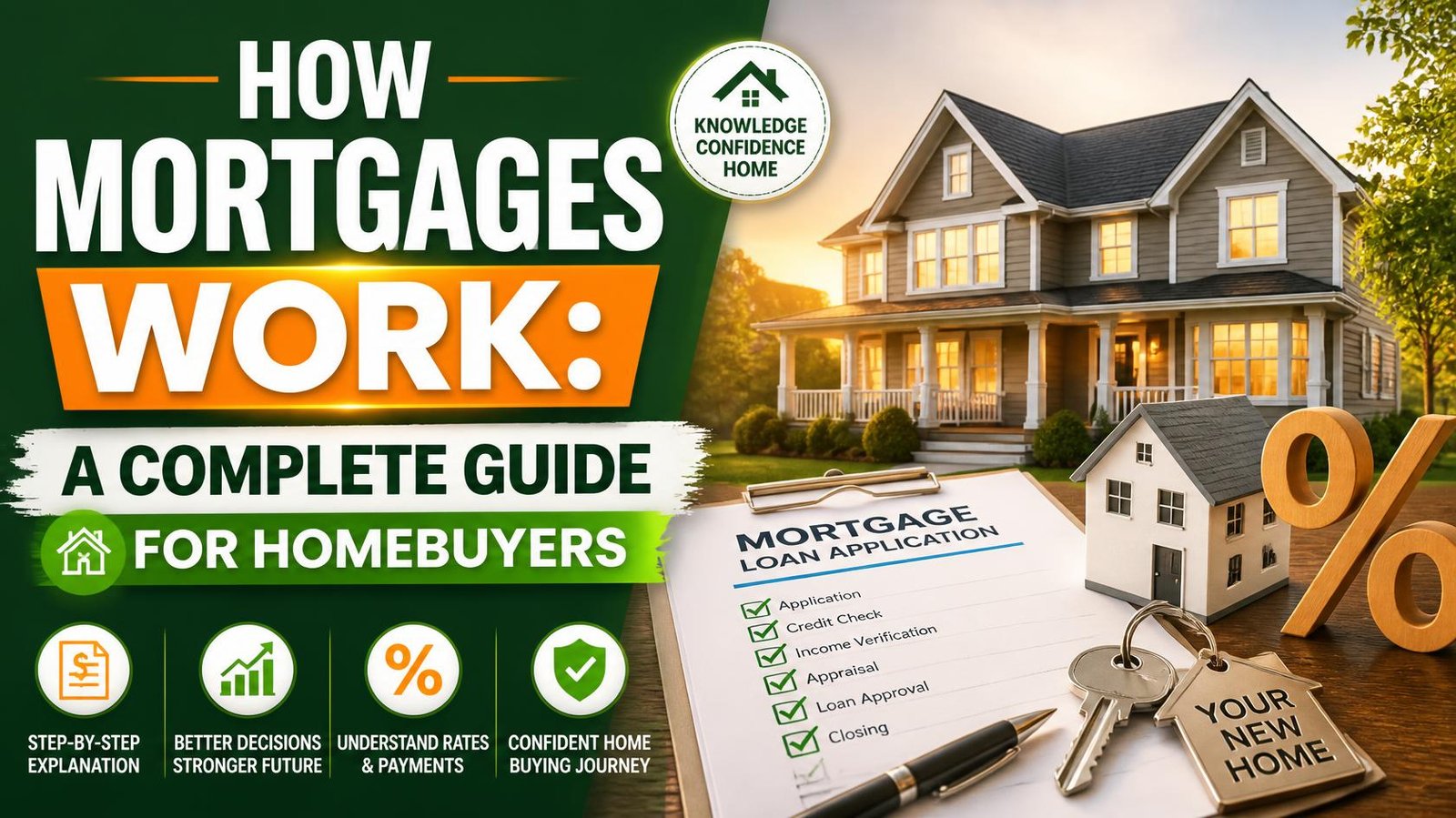
How Mortgages Work: A Complete Guide for Homebuyers: Buying a home is exciting, but the mortgage can feel like a completely different language. Principal, interest, escrow, APR, closing costs, down payment — there is a lot to understand before signing a loan agreement.
The good news is that how mortgages work is easier to understand once you break the process into a few basic parts.
This guide explains the mortgage process, monthly payments, interest rates, down payments, closing costs, loan types, and what to compare before choosing a home loan.
What Is a Mortgage?
A mortgage is a loan used to purchase a home or other real estate. You borrow money from a lender and agree to repay it over a specific period, usually with interest.
The home generally serves as collateral for the loan. If the borrower does not meet the loan obligations, the lender may have legal rights to the property under the terms of the mortgage and applicable law.
In simple terms:
Home price − down payment = mortgage amount
For example, if a home costs $300,000 and you make a $60,000 down payment, you would need to finance $240,000, before considering other transaction costs.
How Does a Mortgage Work?
The mortgage process usually starts when you determine your budget and compare lenders. You provide financial information, the lender evaluates your application, and you receive loan terms if approved.
The basic process looks like this:
- Determine how much home you can comfortably afford.
- Save for a down payment and other upfront costs.
- Compare mortgage lenders and loan options.
- Apply for a mortgage.
- Review the Loan Estimate and loan terms.
- Complete the required home and loan steps.
- Review your Closing Disclosure.
- Sign the final documents and close on the home.
The amount a lender says you qualify for is not necessarily the amount you should spend. Your own budget should account for your other expenses, savings goals and the complete cost of owning the home.
What Is Included in a Monthly Mortgage Payment?
A mortgage payment is often more than just the loan and interest.
The main components can include:
- Principal: The amount borrowed that you repay.
- Interest: The lender’s charge for providing the loan.
- Property taxes: Taxes charged by your local government.
- Homeowners insurance: Insurance that helps protect the property.
- Mortgage insurance: May apply to certain loans, particularly when the down payment is below a lender’s required threshold.
- Escrow: An account that may be used to collect money for property taxes and insurance.
These costs are commonly described using the term PITI: principal, interest, taxes and insurance.
One important point: your principal and interest payment can stay stable with a typical fixed-rate mortgage, while taxes and insurance costs can change. That means your total monthly housing cost may change even when your mortgage rate stays the same.
How Mortgage Interest Works
Interest is the cost of borrowing money.
With a typical amortizing mortgage, each payment is divided between interest and principal. Early in the loan, a larger portion of the payment generally goes toward interest because the outstanding balance is higher. As the balance decreases, more of the payment goes toward principal.
This process is called mortgage amortization.
Over time, paying down the principal builds equity in the property, assuming the home’s value and other factors are considered separately.
How Much Down Payment Do You Need?
There is no single down payment amount that applies to every homebuyer.
The amount required depends on the mortgage program, lender requirements and the borrower’s circumstances. Some mortgage options allow relatively small down payments, while other buyers choose to put down more.
A larger down payment can reduce the amount you need to borrow. Depending on the loan, it may also affect your interest rate, mortgage insurance requirements and overall borrowing costs.
Don’t forget that your cash requirement is not limited to the down payment. You may also need money for closing costs, prepaid expenses, moving expenses and immediate repairs.
What Are Mortgage Closing Costs?
Closing costs are expenses associated with getting the mortgage and completing the home purchase.
They can include:
- Lender origination charges
- Appraisal fees
- Title-related services
- Government recording or transaction fees
- Prepaid interest
- Homeowners insurance
- Initial escrow deposits
- Other third-party services
Closing costs vary by transaction, location, lender and loan type. Freddie Mac notes that they commonly fall around 2% to 5% of the purchase price, although actual costs can be higher or lower.
Because these costs can be significant, don’t compare mortgages using the interest rate alone. Look at the overall cost of the loan.
Fixed-Rate vs. Adjustable-Rate Mortgages
Two common mortgage structures are fixed-rate mortgages and adjustable-rate mortgages (ARMs).
Fixed-Rate Mortgage
With a fixed-rate mortgage, the interest rate does not change during the loan term. This can make principal-and-interest payments easier to plan for.
Adjustable-Rate Mortgage
With an ARM, the interest rate can change according to the terms of the loan after an initial period. The timing and amount of possible adjustments depend on the specific mortgage.
If you’re considering an ARM, pay close attention to how and when the rate can change, as well as applicable caps and the potential effect on your future payment.
What Should You Compare When Shopping for a Mortgage?
Don’t choose a mortgage based on the advertised interest rate alone.
Compare:
- Interest rate
- APR
- Loan term
- Monthly principal and interest
- Estimated total monthly payment
- Down payment requirement
- Mortgage insurance
- Closing costs
- Points
- Lender credits
- Adjustable-rate features, if applicable
- Prepayment penalties or other special terms
The APR can be useful because it provides a broader measure of borrowing costs than the interest rate alone.
The CFPB also recommends comparing written loan offers so you can make a more meaningful, side-by-side comparison between lenders.
What Is Escrow?
An escrow account may be used by your mortgage servicer to collect money for expenses such as property taxes and homeowners insurance.
Instead of paying a large tax or insurance bill separately, part of the amount may be collected with your regular mortgage payment and held until the bill is due.
Escrow arrangements vary, so check your Loan Estimate and mortgage documents to see which expenses are included in your payment.
What Happens at Mortgage Closing?
Closing is the final stage of the home purchase and mortgage process.
Before closing, carefully review your Closing Disclosure. It shows important information about your loan, estimated total monthly payment, closing costs and the amount you need to bring to closing.
At closing, the required parties sign the final documents. Once the transaction is completed, the mortgage becomes your responsibility and you begin making payments according to the loan agreement.
Common Mortgage Mistakes to Avoid
A mortgage can become expensive when buyers focus only on the purchase price.
Try to avoid these common mistakes:
Looking only at the interest rate: A lower rate does not automatically mean a lower overall cost.
Ignoring closing costs: Your down payment is only one part of the money needed to purchase a home.
Forgetting taxes and insurance: Your total housing cost may be higher than principal and interest.
Borrowing the maximum amount available: Qualification and affordability are not the same thing.
Not comparing lenders: Different lenders can offer different rates, fees and loan terms.
Skipping the fine print: Understand how the rate, payment, fees and other terms work before signing.
Frequently Asked Questions
A first-time buyer typically applies for a home loan, provides financial information, receives loan terms, completes the lender’s requirements and closes on the property. The buyer then repays the mortgage through scheduled payments over the loan term.
Principal is the amount borrowed. Interest is the cost charged by the lender for borrowing that money.
No. A down payment reduces the amount you borrow, while closing costs are separate expenses associated with the mortgage and home purchase.
It can. With a fixed-rate mortgage, the principal-and-interest portion generally remains stable, but taxes, insurance and escrow amounts can change. Adjustable-rate mortgages can also have changing interest rates and payments according to their terms.
There is no single mortgage that is best for everyone. The right option depends on your finances, home price, down payment, loan term, interest rate, expected costs and personal circumstances.
Final Takeaway
Understanding how mortgages work can make the homebuying process much less confusing.
The key is to look beyond the advertised mortgage rate. Consider the down payment, principal, interest, taxes, insurance, mortgage insurance, closing costs and the full monthly payment.
Before choosing a mortgage, compare written offers from multiple lenders and make sure the payment fits comfortably within your overall budget. A home purchase is a long-term financial commitment, so understanding the numbers before closing can help you make a more informed decision.
1 thought on “How Mortgages Work: A Complete Guide for Homebuyers”