
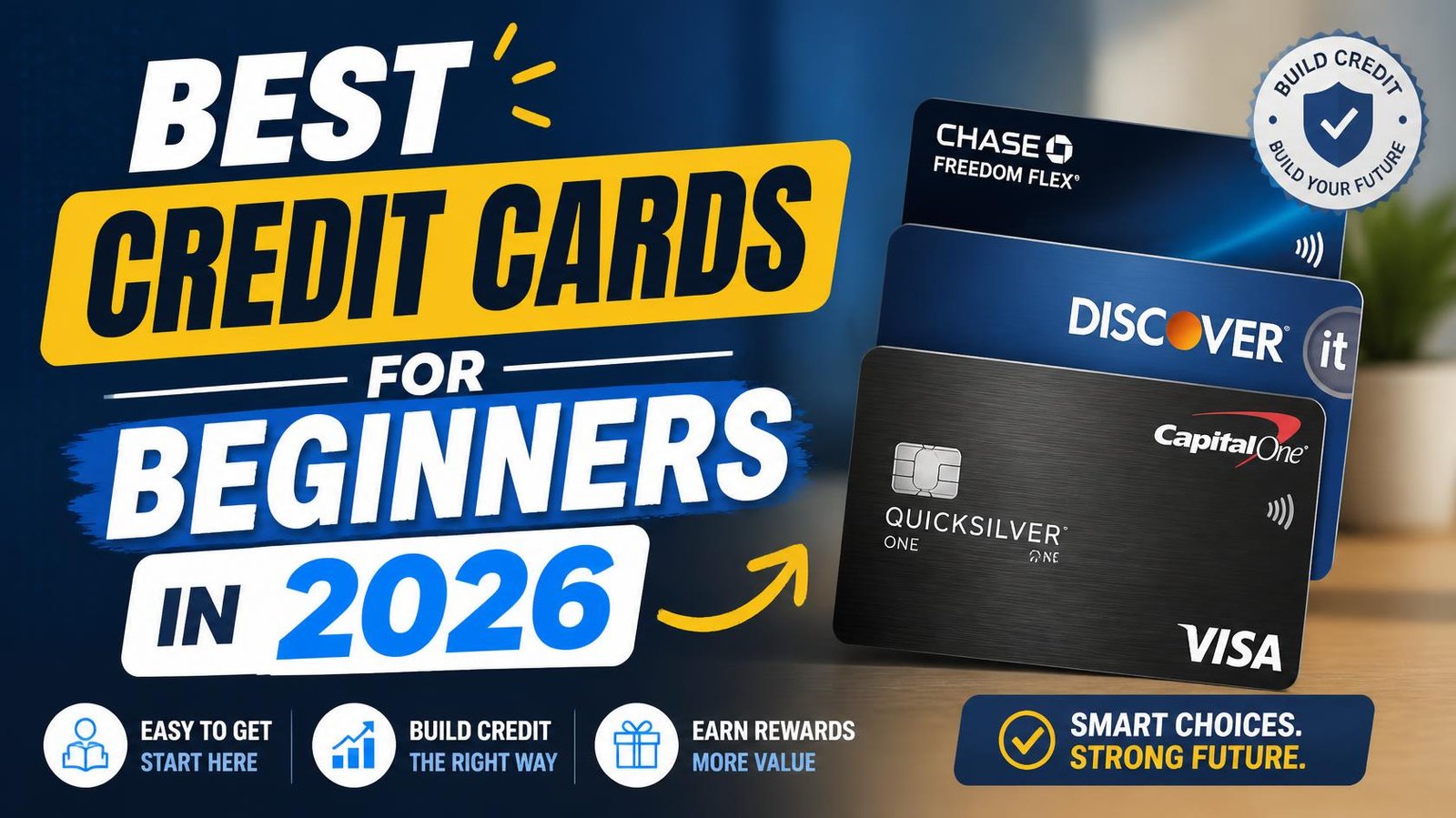
Getting your first credit card can feel surprisingly complicated.
There are cash-back cards, student cards, secured cards, cards for people with no credit history, cards with annual fees, cards with introductory offers, and dozens of other options. A beginner can easily end up focusing on the biggest rewards instead of the features that actually matter when building credit.
The good news is that your first credit card does not need to be complicated.
For most first-time applicants, the goal is simple: find a card that fits your credit profile, has manageable costs, and makes it easy to build a positive payment history.
Some cards stand out because they are designed for people who are new to credit. Others are better suited to students or applicants who need a secured card. The right choice depends on where you are starting and how you plan to use the card.
This guide covers the best credit cards for beginners in 2026, what makes a good starter card, how secured and student cards work, and the habits that can help you build credit over time.
Important: Credit card offers, interest rates, rewards, fees and eligibility requirements can change. Always review the issuer’s current terms before applying.
Quick Look: Best Credit Cards for Beginners
| Card | Best for | Annual fee | Why beginners may consider it |
| Chase Freedom Rise® | First-time credit users | $0 | Designed with new-to-credit customers in mind |
| Capital One Savor Student | Students who want rewards | $0 | Strong rewards on everyday student spending |
| Capital One Quicksilver Student | Simple cash back | $0 | 1.5% cash back on every purchase |
| Discover it® Student Cash Back | Students who like category rewards | $0 | Rotating cash-back categories |
| Discover it® Secured | Building or rebuilding credit | $0 | Secured structure with cash-back potential |
| Bank of America® Secured cards | Secured-card applicants | Varies by product | Option for applicants who may not qualify for an unsecured card |
This table is a starting point, not a universal ranking. A student with limited credit may have very different needs from an adult who has never used credit before.
What Makes a Credit Card Good for Beginners?
The best beginner credit card is not necessarily the one advertising the biggest bonus.
When you are opening your first account, look at the bigger picture.
1. Low or no annual fee
A $0 annual fee can make a first credit card easier to keep for the long term.
That matters because the age of your credit accounts can become part of your overall credit profile. Closing an older card can also affect your credit utilization if you lose some of your available credit.
2. Easy-to-understand rewards
Rewards can be useful, but complicated reward structures are not necessary for a first card.
A straightforward 1.5% cash-back card, for example, may be easier to understand than a card with multiple spending categories and redemption rules.
3. A realistic approval profile
A premium rewards card may look attractive, but that does not mean it is appropriate for someone with no credit history.
Beginners should first identify whether they have:
- No credit history
- Limited credit history
- Student status
- Existing credit problems
- A credit score that qualifies for mainstream cards
4. Tools for responsible credit management
A good beginner card should make it easy to monitor transactions, payments and statements.
Automatic payments, account alerts and mobile access can reduce the chance of missing a payment.
The Consumer Financial Protection Bureau recommends paying loans and credit accounts on time and keeping balances from getting too close to the credit limit.
Best Credit Cards for Beginners in 2026
1. Chase Freedom Rise® — Best for First-Time Credit Users
If your biggest concern is finding a first credit card when you are new to credit, Chase Freedom Rise is one of the cards worth researching.
The card is specifically positioned toward people who are beginning their credit journey. It does not require the same type of established credit history that some premium credit cards expect.
The card also has a $0 annual fee and earns cash back, giving beginners an opportunity to start building credit while receiving rewards.
One reason it stands out is that it focuses more on accessibility for newer credit users than many mainstream rewards cards.
Best for: People applying for their first traditional credit card.
Why consider it:
- $0 annual fee
- Cash-back rewards
- Designed with newer credit users in mind
- Useful for establishing a first credit account
A first-time applicant should still understand that no credit card is guaranteed approval. Issuers make their own underwriting decisions based on the applicant’s overall information.
2. Capital One Savor Student — Best for Student Rewards
College students often have different spending patterns from other beginners.
Dining, groceries, entertainment and streaming can represent a meaningful part of a student’s monthly spending. Capital One Savor Student is designed specifically for students and currently offers 3% cash back at grocery stores, dining, entertainment and popular streaming services, plus 1% on other purchases.
The card currently has a $0 annual fee.
That combination makes it interesting for students who want both a beginner-friendly credit product and rewards on common purchases.
Best for: Students who spend regularly on food and entertainment.
Potential downside: A rewards structure only helps if the spending would have happened anyway. Buying extra items just to earn cash back can turn a reward into an unnecessary expense.
3. Capital One Quicksilver Student — Best for Simple Cash Back
Some beginners do not want to track spending categories.
That is where a simple flat-rate cash-back card can make sense.
Capital One Quicksilver Student currently offers unlimited 1.5% cash back on every purchase, with a $0 annual fee.
The appeal is its simplicity.
You do not have to remember which category earns a higher reward. If an eligible purchase earns the standard rate, the calculation is straightforward.
Best for: Students who want simple, predictable cash back.
Why beginners may like it:
- $0 annual fee
- 1.5% cash back on purchases
- Straightforward rewards structure
- Designed for students
If you prefer simplicity over category optimization, this type of card can be easier to manage.
4. Discover it® Student Cash Back — Best for Students Who Track Categories
Another option for students is Discover it Student Cash Back.
The card has historically been attractive to students because of its rotating cash-back structure. Current terms should be checked directly with Discover before applying because reward categories and promotional terms can change.
The key difference is that this type of card rewards attention.
If you understand the quarterly categories and use the card for eligible purchases, you may get more value than you would from a simple flat-rate card.
Best for: Students who are comfortable tracking rotating rewards.
Potential downside: If you forget the categories or do not spend in them, the extra reward structure may not provide much practical benefit.
Best Secured Credit Cards for Beginners
Not everyone will qualify for an unsecured credit card.
That does not mean you cannot begin building credit.
A secured credit card typically requires a refundable security deposit that supports the credit line. Because the deposit reduces the issuer’s risk, secured cards can be an option for people who are building or rebuilding credit.
Discover’s secured card, for example, is designed around this model.
The important thing to understand is that a secured credit card is still a real credit card. You are borrowing money and must make payments according to the card agreement.
The deposit does not mean the balance can be ignored.
Discover it® Secured Credit Card
Discover it Secured can be worth considering for applicants who need a secured option.
The major appeal of a secured card is not simply the rewards. It is the opportunity to establish a record of responsible credit use.
For someone with limited or damaged credit, that can be more valuable than chasing a large introductory bonus.
Best for: Applicants who need a secured starting point.
How Do Secured Credit Cards Work?
Here is a simple example.
Suppose a card requires a $200 refundable deposit and gives you a $200 credit limit.
You use the card for $50 of normal expenses.
You still owe the $50.
The security deposit does not pay your monthly bill. You must make the required payment yourself.
If you consistently use the card responsibly and pay according to the terms, the account can contribute to your credit history when reported to the credit bureaus.
The CFPB notes that using a credit card and paying on time can help build credit, while paying balances in full can help avoid finance charges.
Best First Credit Card for No Credit
If you have no credit history, the best first credit card is usually one designed for people with limited or new credit rather than a premium card aimed at established borrowers.
Start by asking:
- Do I have any credit history?
- Am I a student?
- Do I have a steady source of income?
- Can I qualify for an unsecured card?
- Would a secured card make more sense?
- Does the card have an annual fee?
- Can I comfortably pay the balance every month?
A lack of credit history is different from having bad credit.
With no credit history, the lender simply has less information about how you handle borrowed money. That is one reason starter and secured products exist.
What Credit Score Do You Need for a Beginner Credit Card?
There is no single credit score that guarantees approval for every beginner credit card.
Credit scoring models consider several factors, including payment history, current debt, the amount of available credit being used, the age of accounts, new credit applications and other information in your credit reports.
Some beginner cards are designed for people with limited or no credit history, while other cards expect established credit.
That means searching for “what credit score do I need for a credit card” is only part of the answer.
Your complete credit profile matters.
How to Choose Your First Credit Card
Instead of choosing a card because it is popular, use this simple process.
Step 1: Check your credit situation
Find out whether you have no credit history, limited credit history or an established score.
Checking your own credit information does not automatically mean you are applying for new credit.
Step 2: Decide what matters most
For a first card, your priority might be:
- Building credit
- Cash back
- Student rewards
- No annual fee
- A secured starting option
- Simple account management
Pick the feature that solves your actual problem.
Step 3: Look at the APR, even if you plan to pay in full
A credit card’s annual percentage rate matters because carrying a balance can result in interest charges.
A card offering excellent rewards can still be expensive if you regularly carry a balance.
For example, Capital One currently lists a variable purchase APR range on Savor Student, demonstrating why applicants should check the current terms rather than assuming every beginner card has the same rate.
Step 4: Check the fees
Look beyond the annual fee.
Read the current pricing and terms for:
- Annual fees
- Late-payment fees
- Balance transfer fees
- Foreign transaction fees
- Cash advance fees
- Other account charges
Step 5: Look at the rewards realistically
Ask yourself:
Would I make these purchases anyway?
If yes, rewards can be useful.
If you are spending extra money just to earn points or cash back, the reward is not really saving you money.
How to Build Credit With Your First Credit Card
Getting approved is only the beginning.
The way you manage the account is much more important.
Pay on time
Payment history is one of the most important elements considered by credit scoring models. The CFPB specifically recommends paying on time, every time.
Setting up automatic payments for at least the required amount can help reduce the risk of forgetting a due date.
Keep balances manageable
Credit utilization refers to how much of your available revolving credit you are using.
For example, if your credit limit is $1,000 and your balance is $200, your utilization is 20%.
The CFPB advises consumers not to get close to their credit limit and notes that experts often advise keeping utilization at or below 30%.
That 30% figure should not be treated as a magic number. Lower utilization can be helpful, and paying the statement balance in full is generally a strong habit.
Pay the statement balance when possible
You do not need to carry a balance to build credit.
That is one of the most important lessons for a first-time cardholder.
The CFPB recommends paying balances in full each month to avoid finance charges when possible.
Avoid opening cards just for rewards
Applying for multiple cards in a short period can create unnecessary hard inquiries and multiple new accounts.
A beginner usually benefits more from learning how to manage one account well than from collecting several cards.
Common First Credit Card Mistakes to Avoid
Mistake 1: Treating the credit limit like free money
A $1,000 credit limit does not mean you have an extra $1,000 of income.
It means the issuer has allowed you to borrow up to a certain amount under the card agreement.
Mistake 2: Carrying a balance because you think it builds credit
You do not need to pay interest to build a credit history.
Responsible use and on-time payments matter.
Mistake 3: Chasing every welcome bonus
A $100 or $200 bonus can look attractive.
If earning it requires spending money you would not normally spend, the bonus may not be worth the extra expense.
Mistake 4: Ignoring the statement
Your credit card statement tells you:
- Current balance
- Minimum payment
- Payment due date
- Transactions
- Fees
- Interest information
Read it every month.
Mistake 5: Applying for too many cards
More cards do not automatically mean better credit.
A strong credit profile comes from responsible management over time, not from collecting accounts.
Mistake 6: Closing an old card without understanding the impact
Closing a credit card can reduce your available credit and potentially increase your utilization ratio. The impact varies depending on your complete credit profile.
Does Using a Credit Card Help Build Credit?
Yes, responsible credit card use can help establish a credit history.
The basic formula is not complicated:
Use credit → pay on time → keep debt manageable → repeat consistently.
Credit scoring models consider factors such as payment history, amounts owed, length of credit history, new credit and credit mix.
There is no legitimate shortcut that instantly creates an excellent credit score.
Building credit is a long-term process.
How Long Does It Take to Build Credit With a First Credit Card?
There is no universal timeline.
Your credit profile develops as information about your account is reported and as you establish a pattern of responsible borrowing.
FICO notes that improving a credit score generally takes patience and consistent behavior rather than a quick fix.
That is why your first credit card should be viewed as the beginning of a financial history, not a quick way to get a high credit score.
Is a Student Credit Card Better for Beginners?
It can be, if you qualify as a student and the card’s features match your spending.
Student cards are often designed around the needs of college students and may provide rewards without requiring the applicant to start with an extensive credit history.
Capital One, for example, currently offers student versions of both Savor and Quicksilver.
A student should still compare fees, APR, rewards, eligibility and account terms before applying.
Can You Get a Credit Card With No Credit History?
Yes, some cards are designed specifically for people who are new to credit.
Possible starting points include:
- Beginner-oriented unsecured cards
- Student credit cards
- Secured credit cards
- Credit-builder products
The best option depends on your circumstances and what the issuer offers you.
If you have no credit history, do not assume that a premium rewards card is your only route.
Should Beginners Choose Cash Back or Travel Rewards?
For a first credit card, cash back is often easier to understand.
Travel rewards can be valuable for someone who travels regularly and understands points, transfer partners and redemption rules.
A beginner who simply wants an easy reward system may prefer a straightforward cash-back card.
The most valuable reward is the one you can actually use without changing your spending habits.
What Is More Important: Rewards or Credit Building?
For a first card, credit-building fundamentals should come first.
A card that gives 3% cash back is not necessarily better than a 1.5% card if the higher-reward card has features you do not understand or encourages unnecessary spending.
Think of rewards as a bonus.
Your primary objective should be establishing a reliable credit history.
Frequently Asked Questions
There is no single best card for everyone. Chase Freedom Rise can be worth considering for people who are new to credit, while student cards from Capital One and Discover may be more appropriate for eligible students. Secured cards can be useful for people who need a different entry point.
Look for a card specifically designed for new or limited-credit applicants. A beginner-oriented unsecured card, student card or secured card may be appropriate depending on your profile.
Yes. A secured card can be a useful starting point when an applicant cannot qualify for a conventional unsecured card. It typically requires a refundable security deposit.
No. Carrying a balance is not required to build credit. Paying your balance in full can help you avoid interest charges.
It can be helpful because you can keep the account open without paying an annual membership fee, assuming the card remains useful and the issuer’s terms continue to suit you.
Try not to get close to your credit limit. The CFPB notes that experts commonly advise keeping credit usage at no more than 30% of the total limit, though utilization is only one part of a credit profile.
Responsible use can help establish and strengthen your credit history over time. Payment history, amounts owed, account age, new credit and other factors all contribute to credit scoring.
Usually, there is no need to rush. Learning how to manage one account responsibly can be more useful than opening several accounts at once.
Final Takeaway
The best credit card for beginners is not necessarily the card with the flashiest rewards or biggest sign-up bonus.
It is the card that fits your credit profile and encourages good financial habits.
For someone completely new to credit, a beginner-focused card such as Chase Freedom Rise may be worth researching. Eligible students can compare options such as Capital One Savor Student, Capital One Quicksilver Student and Discover it Student Cash Back. Applicants who need a secured option can look at cards such as Discover it Secured.
The most important part comes after approval.
Use the card for purchases you can afford, make payments on time, monitor your balance, avoid unnecessary debt and give your credit history time to develop.
A first credit card is not just another payment method. Used responsibly, it can become the foundation of your long-term credit profile.
Always check the issuer’s current rates, fees, rewards, eligibility requirements and terms before submitting an application.
3 thoughts on “Best Credit Cards for Beginners in 2026”