
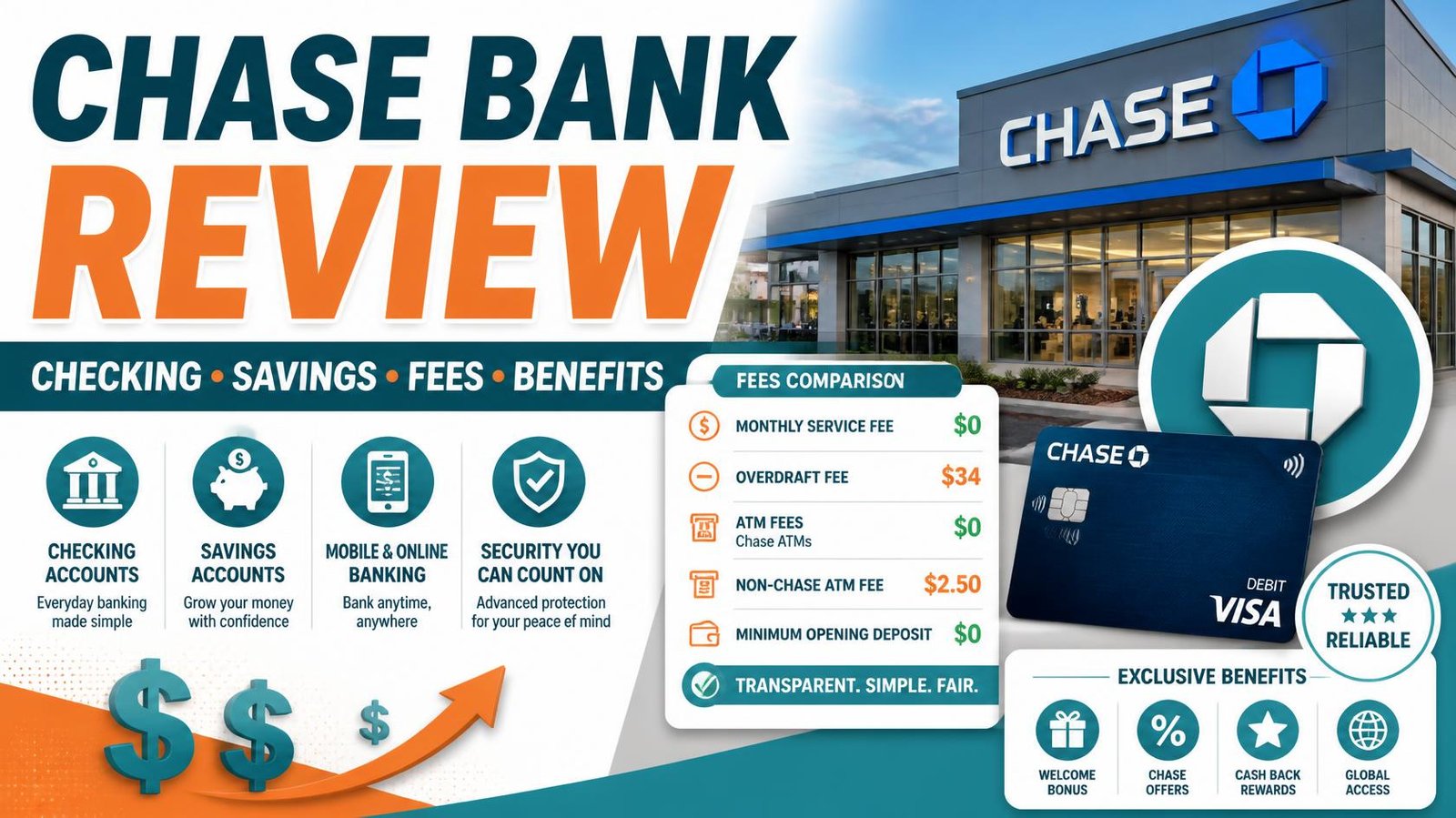
Choosing a bank is about more than finding a place to keep your money. Monthly fees, ATM access, branch availability, mobile banking, savings options and account requirements can all affect how convenient your everyday banking experience becomes.
That is where Chase Bank stands out as a major option for people who want access to both traditional branches and digital banking tools.
In this Chase Bank review, we look at Chase checking and savings accounts, monthly fees, ways to avoid those fees, ATM access, mobile banking, account benefits, potential drawbacks and the key things to consider before opening a Chase account.
The goal is simple: give you the information you need to understand how Chase banking works without making the decision for you.
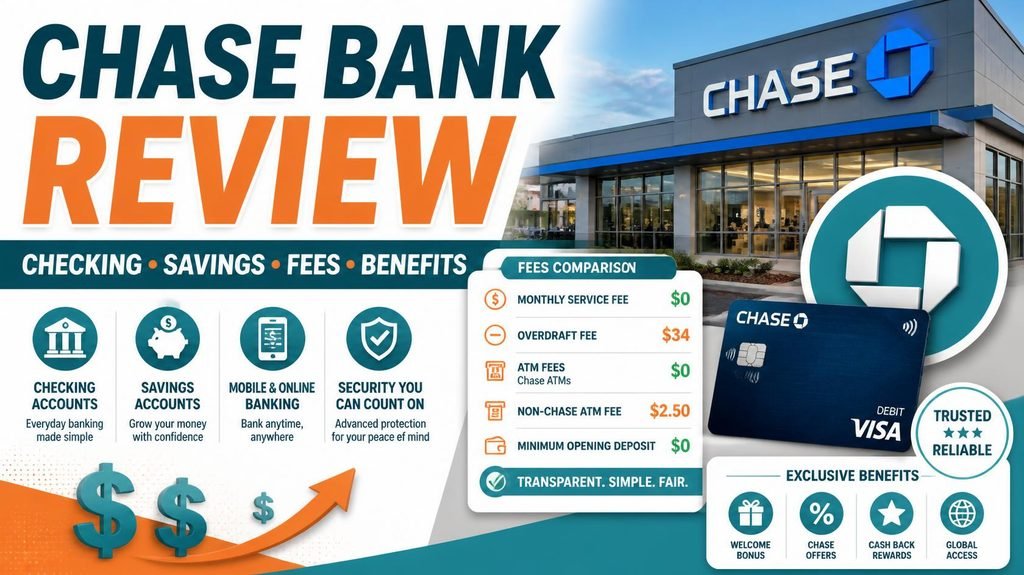
What Is Chase Bank?
Chase Bank, officially JPMorgan Chase Bank, N.A., is the consumer banking arm of JPMorgan Chase. It offers personal checking and savings accounts along with credit cards, loans, mortgages, investment services and other financial products.
For everyday banking, two of the accounts many customers may encounter are Chase Total Checking and Chase Savings.
Chase also offers other checking options, including Chase Secure Checking, Chase Premier Plus Checking, Chase Sapphire Checking and Chase Private Client Checking. The features, fees and eligibility requirements vary between accounts.
One of Chase’s major advantages for customers who prefer in-person banking is its large U.S. branch and ATM network. Chase states that customers have access to more than 14,000 ATMs and 5,000 branches.
Chase Bank at a Glance
| Feature | Chase |
| Bank type | National bank |
| Common checking option | Chase Total Checking |
| Common savings option | Chase Savings |
| Branch access | Yes |
| ATM network | More than 14,000 Chase ATMs |
| Mobile banking | Chase Mobile app |
| Online banking | Yes |
| Monthly fees | Depend on account and eligibility |
| FDIC insurance | Eligible deposits are insured up to applicable limits |
| Zelle | Available with eligible Chase accounts |
| Account options | Checking, savings and other financial products |
The exact terms, rates and fees depend on the specific account, so it is important to check the current account disclosures before opening one.
Chase Checking Account Review
For everyday spending, Chase Total Checking is one of the bank’s main consumer checking products.
It is designed for routine banking such as receiving qualifying electronic deposits, paying bills, using a debit card, withdrawing cash and managing money through Chase’s online and mobile banking platforms.
Chase Total Checking Monthly Fee
Chase Total Checking currently has a $15 monthly service fee, but customers can avoid it by meeting one of several requirements during each monthly statement period.
Chase lists these options:
- $500 or more in qualifying electronic deposits
- Maintaining at least $1,500 at the beginning of each day
- Maintaining $5,000 or more in average beginning-day balances in the account or in combination with certain linked qualifying personal deposits or investments
- Linking the account to a qualifying checking account
This is an important point when evaluating a Chase checking account.
A $15 monthly fee may not be an issue for someone who regularly receives qualifying direct deposits. But if you do not meet one of the waiver requirements, the fee can become an ongoing banking cost.
What Counts as a Qualifying Electronic Deposit?
Not every deposit automatically qualifies.
Chase says qualifying electronic deposits can include payments from an employer or government entities, including certain benefits and tax refunds, when made through eligible electronic payment networks.
Chase also specifically states that transactions such as Zelle transfers, cash deposits, checks, wire transfers and interest payments do not count as qualifying electronic deposits for this purpose.
That distinction is easy to overlook, so anyone opening the account primarily to avoid the monthly fee should understand the requirement.
Chase Savings Account Review
The Chase Savings account is designed for customers who want a separate place to set money aside while keeping their banking relationship with Chase.
One feature Chase promotes is Autosave, which can help customers move money from a Chase checking account into savings automatically.
Chase Savings Monthly Fee
Chase Savings currently has a $5 monthly service fee.
The fee can be reduced to $0 when the customer meets at least one qualifying condition during the monthly statement period.
According to Chase, the available ways include:
- Maintaining a $300 or higher balance at the beginning of each day
- Making at least $25 in total Autosave or other repeating automatic transfers from a personal Chase checking account
- Linking the savings account to a qualifying checking account
- Linking it to a Chase College Checking account enrolled in Overdraft Protection
- Being under age 25
This makes the account more practical for customers who already use Chase checking and can meet one of the waiver conditions.
Does Chase Savings Pay Interest?
Yes. Chase Savings is an interest-bearing savings account, but the interest rate is variable and can change.
Chase states that savings interest is based on the daily collected balance and is compounded and credited monthly. Account fees can reduce the amount earned.
Because savings rates can change, anyone comparing Chase with other banks should check the current APY rather than relying on an old rate mentioned in another article.
Chase Bank Fees
Bank fees are one of the most important things to understand before opening any account.
Chase has different fee structures depending on the product.
For example:
| Account | Monthly Service Fee | Ways to Avoid It |
| Chase Total Checking | $15 | Several qualifying options, including $500+ qualifying electronic deposits |
| Chase Savings | $5 | $300+ balance, qualifying automatic transfers, qualifying linked account and other options |
| Chase Secure Checking | $4.95 | Qualifying electronic deposits, linked qualifying account or certain age eligibility |
| Chase Premier Savings | $25 | $15,000+ balance or qualifying linked checking account |
These figures reflect Chase’s current published information and can change when the bank updates its product terms.
Other Chase Fees
Monthly service fees are only one part of the picture.
Depending on the account and transaction, customers may encounter fees related to services such as:
- Non-Chase ATM transactions
- Wire transfers
- Certain account services
- International transactions
- Other specialized banking services
The exact amount depends on the account and transaction. Chase publishes a separate fee schedule and account agreement for additional details.
For that reason, it is better to check the fee schedule for the exact account instead of assuming every Chase customer pays the same fees.
Chase ATM Access
One of the biggest practical benefits of Chase is its large physical banking network.
Chase says it provides access to more than 14,000 ATMs and 5,000 branches.
For customers who regularly need cash or prefer face-to-face banking, this can be an important consideration.
Using a Chase ATM generally avoids a Chase ATM fee. Non-Chase ATM transactions can have different costs depending on the account and location, and the ATM owner may also charge its own surcharge.
For frequent travelers, it is especially important to review the account’s current ATM and international transaction terms.
Chase Mobile and Online Banking
Chase is not limited to traditional branch banking.
Customers can manage many everyday banking tasks through Chase’s online banking platform and Chase Mobile app.
Depending on the account and service, digital banking can help customers:
- Check account balances
- Review transactions
- Transfer money
- Pay bills
- Deposit eligible checks
- Send and receive money through Zelle
- Set account alerts
- Manage savings
- Monitor spending
Chase itself recommends using account alerts and its mobile app to help customers keep track of balances and spending.
For people who prefer to manage most of their finances from a phone, digital access can be an important part of the overall banking experience.
Chase Bank Benefits
There are several features that may make Chase attractive to certain customers.
1. Large Branch and ATM Network
Customers who want access to physical banking locations may value Chase’s extensive branch and ATM network.
With more than 5,000 branches and 14,000 ATMs, Chase has a substantial physical presence in the United States.
2. Multiple Account Options
Chase offers multiple checking and savings products rather than putting every customer into one account.
That gives customers different options depending on their banking needs, balances and eligibility.
3. Strong Digital Banking Tools
The Chase mobile and online banking platforms provide access to many everyday banking functions without requiring a branch visit.
4. Checking and Savings Under One Bank
Some people prefer keeping their checking and savings accounts at the same institution.
With Chase, customers can connect eligible accounts and use features such as automatic savings transfers.
5. Additional Financial Products
Chase offers more than deposit accounts.
Its broader financial ecosystem includes credit cards, mortgages, auto financing, personal financial services and investment-related products.
For customers who want several financial products from one large institution, having multiple services under the same banking relationship may be convenient.
Potential Drawbacks of Chase Bank
A balanced Chase Bank review should also look at potential disadvantages.
Monthly Service Fees
Some Chase accounts have monthly service fees if the customer does not meet the requirements for a waiver.
For example, Chase Total Checking has a $15 monthly fee when none of its listed waiver conditions are met. Chase Savings has a $5 monthly fee when its waiver requirements are not met.
Savings Rates May Not Be the Main Attraction
Chase Savings offers variable interest, but customers comparing savings accounts should look at the current APY and compare it with other available options.
The right comparison depends on the customer’s balance, access requirements and overall banking needs.
Some Fees Require Attention
As with many financial institutions, certain services can carry additional fees.
Reading the account’s current fee schedule before opening an account can help avoid surprises.
Chase Secure Checking vs Chase Total Checking
Chase offers different checking products, so it is worth understanding the basic difference.
Chase Total Checking is a more traditional checking account with a $15 monthly service fee that can be waived through qualifying conditions.
Chase Secure Checking has a $4.95 monthly service fee, with ways to avoid it including qualifying electronic deposits, a linked qualifying checking account or certain age eligibility. Chase also states that Secure Checking does not charge overdraft fees because customers spend only the money available in the account.
Neither account is automatically the right choice for everyone. The better fit depends on how you receive money, how you use your checking account and which features matter to you.
Is Chase Bank Good for Beginners?
Chase can be useful for people who are opening their first bank account and want access to both online banking and physical branches.
A beginner may find the large ATM and branch network convenient, while the mobile app can handle many everyday tasks.
At the same time, beginners should pay close attention to monthly service fee requirements.
The most important question is not simply “Does Chase have a monthly fee?”
Instead, ask:
Can I consistently meet the requirements that make the fee $0?
If the answer is yes, the monthly fee may not be an actual cost for your situation. If the answer is no, you should include the fee when comparing Chase with other banks.
Is Chase Good for Students?
Chase offers banking products for younger customers, and its current published information includes fee-waiver provisions for certain customers under age 25.
Chase has also expanded its Secure Banking fee waiver to customers ages 17 through 24, regardless of whether they are in college, working or following another path.
Students should still review eligibility requirements and current terms before opening an account because account features and requirements can change.
How to Avoid Chase Bank Fees
Avoiding unnecessary banking fees often comes down to understanding the account rules before you start using it.
Here are some practical steps:
1. Know Your Monthly Fee
Check the exact monthly service fee for your account.
2. Understand the Waiver Requirements
Do not assume every deposit qualifies. Chase distinguishes qualifying electronic deposits from transactions such as cash, checks, Zelle transfers and wire transfers.
3. Use Chase ATMs When Practical
Using an in-network Chase ATM can help avoid certain ATM charges.
4. Set Account Alerts
Balance and transaction alerts can help you monitor your account and spot unexpected activity. Chase provides account alert features through its banking tools.
5. Review the Fee Schedule
Before using services such as wires or international transactions, check the applicable fee.
Who May Consider Chase Bank?
Chase may be worth considering for people who value:
- A large U.S. branch network
- A large ATM network
- Mobile and online banking
- Multiple checking account choices
- A checking and savings relationship at one bank
- Access to additional financial products
- Traditional branch support alongside digital banking
Who Should Compare Other Banks?
It is also reasonable to compare Chase with other banks if your priorities include:
- A different monthly fee structure
- A particular savings APY
- Low ATM fees outside a bank’s network
- A specialized checking account
- A different set of digital banking features
There is no single bank account that works the same way for every customer.
The important thing is to compare the features that actually affect your own banking habits.
Chase Bank Review: Pros and Cons
Potential Pros
- Large branch network
- More than 14,000 Chase ATMs
- Strong online and mobile banking access
- Multiple checking and savings options
- Ways to waive monthly service fees
- Automatic savings tools
- Broad range of financial products
Potential Cons
- Some accounts charge monthly service fees
- Fee-waiver rules vary by account
- Additional fees may apply to certain services
- Savings rates can change
- Customers should compare current APYs and fees with other banks before opening an account
Frequently Asked Questions About Chase Bank
Yes. Chase Bank is the consumer banking business of JPMorgan Chase Bank, N.A. Eligible deposits are covered by FDIC insurance subject to applicable limits.
Yes. Chase operates thousands of branches across the United States. Chase currently states that customers have access to more than 5,000 branches.
Some Chase accounts have monthly service fees. For example, Chase Total Checking currently has a $15 monthly service fee that can be waived by meeting one of several requirements. Chase Savings currently has a $5 monthly service fee that can also be waived through qualifying conditions.
The amount required can depend on the specific Chase account and its current opening requirements. Check the account’s current application page before applying.
Yes. Chase Total Checking provides several ways to avoid its $15 monthly service fee, including qualifying electronic deposits, certain balance requirements or linking to a qualifying checking account.
Yes. Chase states that it has more than 14,000 ATMs.
Yes. Chase Savings has several fee-waiver options, including maintaining a qualifying balance, making qualifying automatic transfers, linking an eligible account or meeting certain age-related eligibility requirements.
Yes. Chase provides online banking and the Chase Mobile app for managing eligible accounts and everyday banking activities.
Yes. Chase Savings earns variable interest based on the daily collected balance. The rate can change, so customers should check the current rate before opening or comparing accounts.
Chase Total Checking has a $15 monthly service fee that can be waived through several qualifying conditions. Chase Secure Checking has a $4.95 monthly service fee and does not charge overdraft fees, according to Chase’s current account information.
Final Thoughts on Chase Bank
Chase is a major U.S. banking option with a combination of physical branches, a large ATM network and digital banking tools.
Its checking and savings accounts come with different fee structures and waiver requirements, so understanding those details is more useful than looking at the bank’s name alone.
For anyone researching a Chase Bank account, the key things to compare are the monthly fee, fee-waiver requirements, current savings rate, ATM access, digital features and the services you actually expect to use.
Banking terms can change over time, so always review Chase’s current account disclosures, fee schedule and interest rates before opening an account.
That small step can help you understand the real cost and benefits of the account rather than relying on an outdated review.
1 thought on “Chase Bank Review Checking, Savings, Fees & Benefits”