
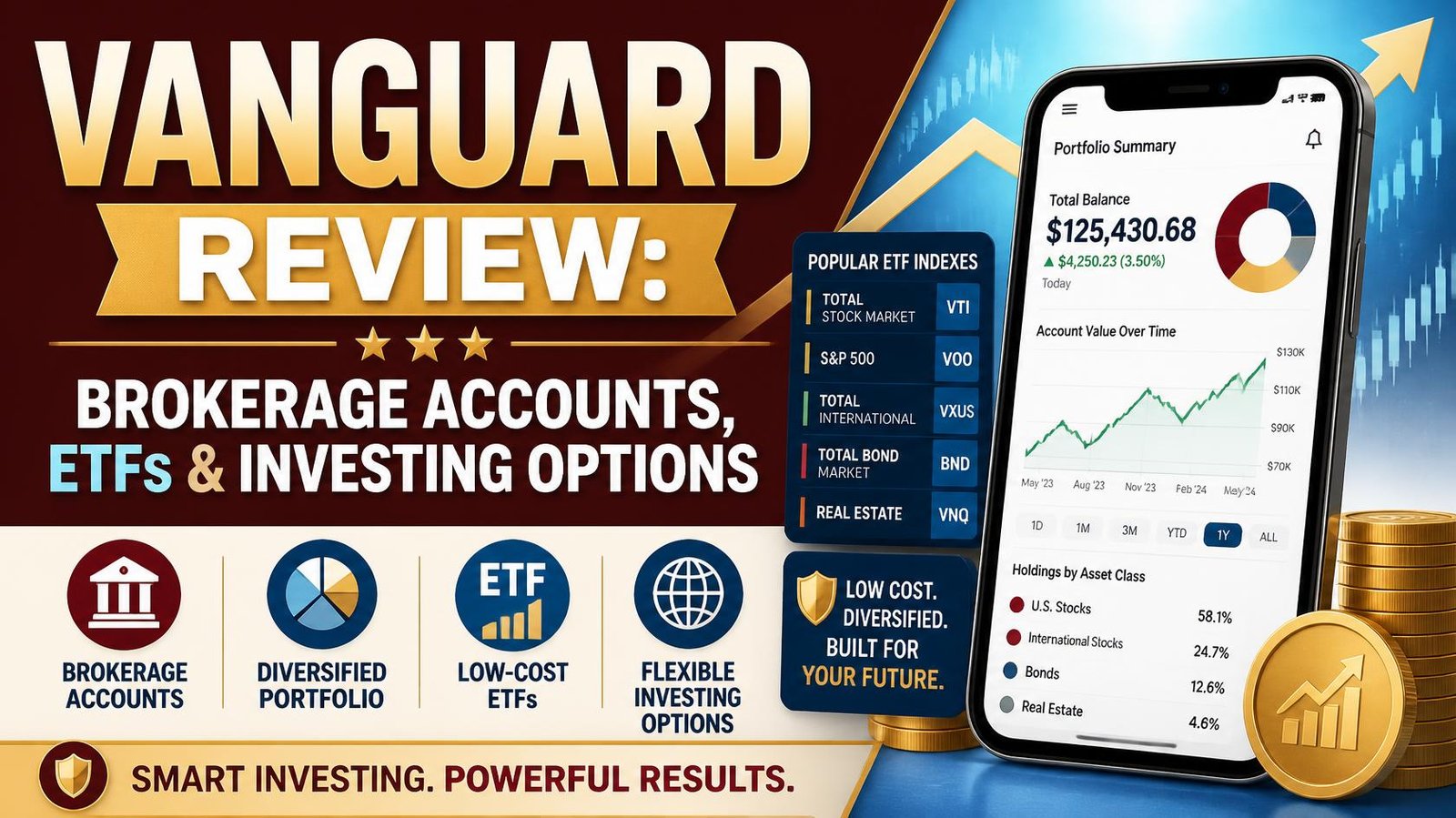
Vanguard Review: Is It a Good Investment Platform?
Choosing an investment platform can feel complicated, especially when you are just starting. You want to understand the fees, available investments, account requirements, and risks before putting your money into the market.
Vanguard is a well-known investment management company that offers brokerage accounts, exchange-traded funds (ETFs), mutual funds, and retirement investing options. It is particularly recognized for index investing and its range of funds designed for different investment objectives.
But is Vanguard suitable for beginners? Can you open an account without a large initial deposit? And what should you know about its fees before investing?
In this Vanguard review, we examine its brokerage accounts, investment options, costs, advantages, and limitations to help you make a more informed decision.
How we verified this article: We checked Vanguard’s official website for brokerage account features, investment minimums, and fee information, alongside educational resources from the U.S. Securities and Exchange Commission (SEC). Product terms and fees can change, so readers should confirm the latest details through the official sources linked below.
What Is Vanguard?
Vanguard is an investment management company that provides investment products and services to eligible investors. Its offerings include ETFs, mutual funds, brokerage accounts, and retirement investment options.
Unlike a traditional bank focused on everyday banking, Vanguard’s brokerage service is designed primarily for investing. Customers can use eligible accounts to purchase investments, monitor their portfolios, and work toward financial goals.
Investors commonly research Vanguard for:
- Long-term investing and portfolio building.
- Stock and bond market exposure through ETFs and mutual funds.
- Retirement savings through eligible individual retirement accounts (IRAs).
- Investment options with different costs and strategies.
- Educational resources about investing and financial planning.
One important point: opening a brokerage account does not automatically mean your money has been invested. You may need to select and purchase investments separately.
Official source: Vanguard Brokerage Accounts.
Vanguard Brokerage Accounts Explained
Vanguard offers different account types depending on an investor’s goals. Understanding the differences can help you select an account that matches your intended use.
1. Standard Brokerage Account
A standard Vanguard brokerage account is a nonretirement investment account. It can be used for goals such as building an investment portfolio, saving toward a future purchase, or investing outside a dedicated retirement account.
According to Vanguard’s official account information, there is no initial minimum investment required simply to open a standard brokerage account.
The account can provide access to eligible ETFs, mutual funds, stocks, bonds, and other investments.
Key features include:
- No annual contribution limit imposed on a standard brokerage account.
- Flexibility to sell investments and withdraw available funds.
- Access to different investment products.
- Potential taxes on dividends, interest, and realized investment gains.
Although withdrawals do not have the early-withdrawal penalties associated with certain retirement accounts, selling investments can result in losses or tax consequences.
2. Traditional IRA
A traditional individual retirement account is designed for retirement savings and may offer tax advantages depending on your eligibility and circumstances.
Contributions may be tax-deductible, subject to applicable rules. Investment earnings generally grow tax-deferred, while withdrawals are usually taxable as ordinary income.
Additional taxes or penalties may apply to certain early withdrawals.
3. Roth IRA
A Roth IRA uses after-tax contributions, and qualified withdrawals can be tax-free under applicable rules.
Eligibility depends on factors such as income and filing status. Contribution limits and withdrawal requirements also apply.
The traditional IRA and Roth IRA have different tax treatments, so it is worth reviewing the official rules before choosing between them.
Official source: Vanguard IRAs.
Vanguard ETFs: What Investment Options Are Available?
Vanguard ETFs are among the company’s best-known investment products. An exchange-traded fund pools investments into a portfolio that follows a particular strategy.
ETFs can offer exposure to many securities through a single investment, although the amount of diversification depends on the fund’s holdings.
Here are some common ETF categories to understand.
Broad Market ETFs
Broad market ETFs provide exposure to a large group of stocks or bonds. Depending on the fund, they may track a broad U.S. stock market index or another market segment.
These funds can simplify portfolio construction, but they do not eliminate market risk.
S&P 500 ETFs
An S&P 500 ETF seeks to track an index representing approximately 500 leading U.S. companies.
Vanguard’s Vanguard S&P 500 ETF, ticker VOO, is one example.
This type of fund offers exposure to companies represented in the index without requiring an investor to purchase every company’s shares individually. Its performance still depends on the underlying market, and it may be significantly affected by large companies in the index.
International Stock ETFs
International ETFs invest in companies outside the United States. Their strategies may focus on developed markets, emerging markets, or a broader collection of international stocks.
These funds can expand geographic diversification, but investors should understand currency, political, and market risks.
Bond ETFs
Bond ETFs hold fixed-income investments, which may include government or corporate bonds.
Depending on their objectives and holdings, they can play a role in a diversified portfolio. Bond funds are not risk-free: interest-rate movements and credit conditions can affect their values.
Before buying any ETF, review its investment objective, holdings, expense ratio, and prospectus.
Official source: Vanguard ETFs and Fees.
Vanguard Mutual Funds vs. ETFs
Vanguard offers mutual funds as well as ETFs. Both can hold diversified portfolios, but their trading methods differ.
| Feature | ETFs | Mutual funds |
| Trading | Generally traded on exchanges throughout the trading day | Generally bought or sold at the next calculated net asset value |
| Pricing | Market price during trading | Calculated net asset value |
| Investment strategy | Can be index-based or actively managed | Can be index-based or actively managed |
| Costs | Expense ratios and possible trading costs | Expense ratios and possible transaction fees |
| Minimum investment | Vanguard ETF purchases can start at $1 per share | Minimums vary by fund |
Index funds aim to track a market index, while actively managed funds use investment managers to make portfolio decisions according to a particular strategy.
Neither approach guarantees a profit. The right option depends on your goals, risk tolerance, costs, and investment preferences.
Vanguard Fees: What Does It Cost?
Fees are an important part of any Vanguard brokerage review. Even relatively small costs can affect long-term investment results.
Vanguard’s official fee schedule lists $0 online commissions for eligible stock and ETF trades under its published brokerage pricing. However, commission-free trading does not mean investing is completely free.
Annual Account Service Fee
Vanguard’s published brokerage information lists a $25 annual account service fee for applicable accounts. The company states that customers can avoid this fee by signing up for electronic delivery of account-related documents, subject to the applicable terms.
ETF Expense Ratios
An ETF’s expense ratio represents its annual operating expenses as a percentage of its assets.
For example, a hypothetical fund with a 0.10% expense ratio would have approximately $10 in annual fund expenses on a $10,000 balance, assuming the balance stays unchanged.
The actual cost depends on the fund’s expense ratio and investment value.
Mutual Fund Fees
Mutual fund expenses and minimum investment requirements vary. Certain non-Vanguard mutual funds may also have transaction fees or other charges.
Other Possible Costs
Depending on the transaction and account, other costs may include broker-assisted commissions, applicable securities transaction fees, bid-ask spreads, and taxes.
Vanguard’s official brokerage fee schedule is effective July 10, 2026, according to the published page reviewed for this article. Because fees and eligibility can change, check the current schedule before opening an account or placing a trade.
Official source: Vanguard Investment Fees and Costs.
Is Vanguard Good for Beginners?
Vanguard can be worth considering for beginners who want to learn about ETFs, index funds, mutual funds, and long-term investing.
Its range of investment products gives new investors several options to research, while its educational resources explain important concepts such as diversification and investment costs.
However, beginners should not assume that choosing a well-known brokerage automatically makes an investment suitable.
Before investing, ask yourself:
- What does this fund actually own?
- What are its annual expenses?
- How much could its value fall?
- Will I need this money soon?
- Does the investment match my financial goals?
A simple portfolio that you understand may be more appropriate than buying several overlapping funds without knowing their underlying holdings.
Vanguard Pros and Cons
| Pros | Cons |
|---|---|
| No initial minimum to open a standard brokerage account | Investment losses are possible due to market fluctuations |
| Wide selection of ETFs, mutual funds, stocks, and bonds | Minimum investment requirements vary by fund |
| Many funds offer relatively low expense ratios | Some account fees and transaction costs may apply |
| Traditional and Roth IRA options are available to eligible investors | Investors must research investment risks and costs |
| Educational resources help investors understand investing | Account availability depends on eligibility and circumstances |
Is Vanguard Safe?
Vanguard’s brokerage service and investment products should be evaluated separately when considering safety.
Vanguard Brokerage Services is a member of the Securities Investor Protection Corporation (SIPC). SIPC protection generally helps eligible customers recover qualifying cash and securities if a member brokerage firm fails, subject to applicable limits and rules.
SIPC protection can cover up to $500,000 per customer, including a $250,000 limit for cash claims. It does not protect against losses caused by a decline in investment value.
For example, if an ETF loses value because the stock market falls, SIPC does not reimburse that market loss.
Investors should also understand that brokerage accounts are not identical to FDIC-insured bank deposit accounts.
Read the SEC’s official SIPC explanation to understand the difference.
Vanguard vs. Other Brokerage Platforms
Vanguard is not the only option for U.S. investors. Fidelity and Charles Schwab are other providers worth comparing.
| Feature | Vanguard | Fidelity | Charles Schwab |
| Known for | Index funds and long-term investing | Brokerage and retirement services | Brokerage services and investment tools |
| Investment choices | ETFs, mutual funds, and other eligible securities | Broad investment selection | Broad investment selection |
| Retirement accounts | Eligible IRA options | Eligible IRA options | Eligible IRA options |
| What to compare | Fees, fund selection, account features | Research tools, costs, and services | Trading tools, costs, and services |
This is a general comparison, not a complete feature or fee ranking. Review each provider’s official disclosures to determine which services are currently available and appropriate for your needs.
Frequently Asked Questions
Vanguard states that there is no initial minimum to open a standard brokerage account. Purchasing investments requires sufficient funds, and investment-specific minimums may apply.
Eligible online ETF trades have no brokerage commission under Vanguard’s published pricing. However, ETFs have operating expenses, and other applicable costs may apply.
Yes. Investments held through Vanguard can lose value, and investors may lose some or all of their invested money. Returns are not guaranteed.
Yes. Vanguard offers eligible retirement accounts, including traditional and Roth IRAs. Contribution eligibility, limits, tax treatment, and withdrawal rules apply.
Vanguard offers investment products that can be used for long-term investing. Suitability depends on the investments selected, their costs, your goals, and your ability to tolerate losses.
Account availability depends on residency, account type, and eligibility rules. International readers should verify their eligibility directly with Vanguard rather than assume that U.S. brokerage services are available to them.
Final Verdict: Is Vanguard Worth Considering?
Vanguard is worth researching if you want to compare brokerage accounts, ETFs, mutual funds, and retirement investment options.
Its accessible standard brokerage account and selection of investment funds may appeal to people building a portfolio for long-term goals. However, fees, account eligibility, and investment risks deserve careful attention.
Before making a decision, review the latest official information, understand what you plan to buy, and compare Vanguard with other brokerage providers.
Official-source verification statement: We reviewed Vanguard’s official brokerage, investment-fee, and ETF resources, along with SEC investor education materials, when preparing this article. Readers should consult those sources for the latest applicable terms.
Disclaimer: This article is for educational purposes only and does not constitute personalized investment, legal, or tax advice. All investments involve risk, including possible loss of principal. Past performance does not guarantee future results.
1 thought on “Vanguard Review: Brokerage Accounts, ETFs & Investing Options”