
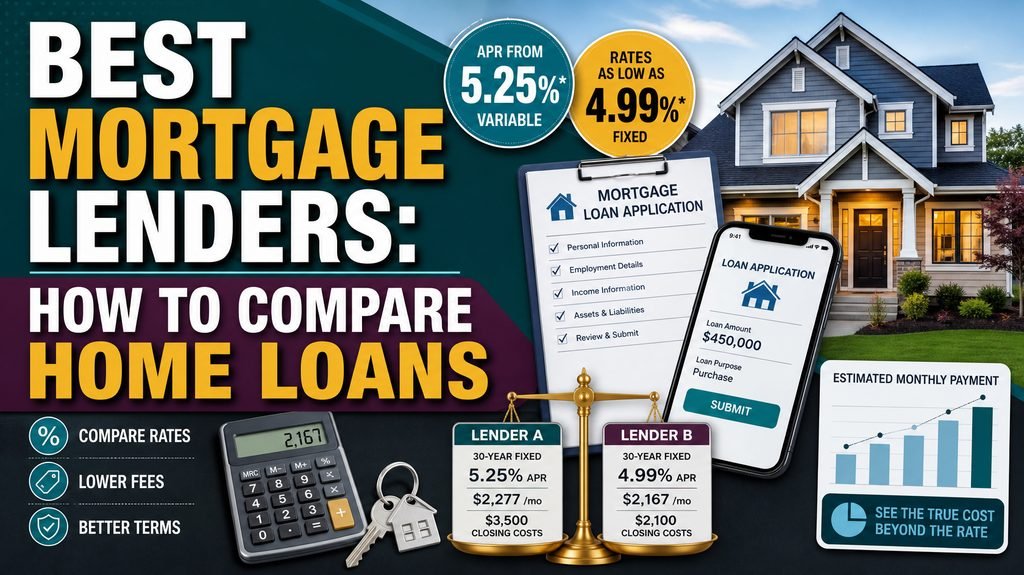
Buying a home is a major financial commitment, and choosing the right mortgage lender can make a meaningful difference in how much you pay over time. While one lender may advertise an attractive interest rate, another may offer different fees, repayment options, or loan programs that better match your financial situation.
For many buyers, especially first-time homebuyers, understanding the mortgage process can feel complicated. There are different loan types, down payment requirements, closing costs, credit considerations, and repayment periods to evaluate before making a decision.
The good news is that you do not have to choose the first mortgage company you find. Comparing multiple lenders and reviewing their actual loan offers can help you understand your options and avoid unnecessary borrowing costs.
In this guide, we explain how to compare the best mortgage lenders in the USA, understand home loan options, review mortgage rates, and choose financing that fits your budget.
What Are Mortgage Lenders?
Mortgage lenders are banks, credit unions, and financial companies that provide financing to people who want to purchase or refinance a home. Borrowers repay the amount borrowed, along with interest, according to the terms of their mortgage agreement.
Common types of mortgage providers include:
- Traditional banks: Financial institutions that offer mortgages alongside other banking services.
- Credit unions: Member-owned institutions that provide financial products to eligible members.
- Online mortgage lenders: Companies that allow borrowers to research, apply for, and manage mortgages digitally.
- Mortgage companies: Businesses that specialize in home financing.
- Mortgage brokers: Intermediaries who help borrowers explore mortgage offers from different lenders.
One important distinction is that the mortgage lender and mortgage servicer are not always the same company. A servicer handles everyday loan administration, such as collecting payments and answering account questions. Your mortgage servicing may be transferred after closing.
Understanding these differences helps you compare mortgage companies based on more than their advertisements.
Best Mortgage Lenders in the USA to Compare
There is no single mortgage company that offers the best deal to every homebuyer. Your eligibility, property location, credit history, loan amount, and financial goals can all affect the options available.
Here are several established providers worth researching when comparing home loans.
1. Chase Home Lending
Chase offers mortgage products for home purchases and refinancing. Its official home lending website provides information about available loan options, purchase rates, mortgage calculators, and home lending advisors.
Visit: Chase Home Lending
2. Bank of America
Bank of America provides mortgage services, including home purchase financing and refinancing options. Buyers can review its mortgage information and explore available programs through its official website.
Visit: Bank of America Mortgage
3. Rocket Mortgage
Rocket Mortgage focuses on home financing through an online mortgage platform. It is worth researching if you prefer digital application tools and online access to mortgage information.
Visit: Rocket Mortgage
4. Wells Fargo
Wells Fargo is a major US financial institution with a history of offering mortgage services. Check its official mortgage website for current product availability and application information.
Visit: Wells Fargo
Important: These companies are examples to research, not a verified ranking of the cheapest mortgage lenders. Product availability, rates, and eligibility can change. Compare written offers before selecting a provider.
Different Types of Mortgage Loans Available
Before choosing a mortgage lender, understand the main home loan options available in the United States. The type of loan you choose affects your down payment, interest costs, mortgage insurance, and eligibility.
1. Conventional Loans
Conventional mortgages are not insured or guaranteed by a federal government agency. They may follow standards established for conforming loans or fall outside those standards.
Some conventional programs allow eligible buyers to purchase a home with a relatively small down payment. Private mortgage insurance (PMI) is generally required when the down payment is below 20%, although applicable program rules and loan structures matter.
2. FHA Loans
FHA loans are offered by approved lenders and insured by the Federal Housing Administration. They can provide financing opportunities for borrowers who meet the program’s requirements.
Eligible borrowers may qualify for a down payment as low as 3.5%, subject to credit and other conditions. FHA loans also involve mortgage insurance premiums, which should be included when comparing total costs.
3. VA Loans
VA loans are backed by the Department of Veterans Affairs and are available to eligible veterans, active-duty service members, and certain surviving spouses.
Eligible borrowers may be able to purchase a home without a down payment. VA loans do not require monthly mortgage insurance, although a funding fee may apply unless the borrower qualifies for an exemption.
4. USDA Loans
USDA home loans support eligible buyers purchasing properties in qualifying rural areas and certain other eligible locations.
The USDA Single Family Housing Guaranteed Loan Program can offer 100% financing to eligible applicants. Income limits, property eligibility, and repayment requirements apply. Program fees may also affect the overall cost.
5. Jumbo Loans
Jumbo mortgages are loans that exceed the applicable conforming loan limits. They are commonly used when financing properties that require borrowing above standard conforming limits.
Lenders may have different requirements for credit, income, cash reserves, and down payments. Compare several jumbo mortgage offers before making a decision.
You can verify these loan categories and their general features through the CFPB’s official mortgage loan guide and the relevant government program websites.
How to Compare Mortgage Lenders Before Choosing One
Finding a mortgage provider is only the beginning. You should compare the actual loan terms to understand which lender offers a suitable overall deal.
1. Compare Interest Rates and APR
The mortgage interest rate determines how much interest you pay on the borrowed amount. Even a small difference in rates can affect your monthly payment and total borrowing costs.
However, do not compare interest rates alone.
The Annual Percentage Rate (APR) provides a broader measure of borrowing costs because it generally includes the interest rate and certain loan-related charges.
Ask each lender about its quoted rate, APR, discount points, and rate-lock conditions. Make sure you are comparing offers issued around the same time.
2. Review Down Payment Requirements
A down payment is the amount you contribute toward the home’s purchase price rather than borrowing from the lender.
Different mortgage programs have different down payment requirements. A larger down payment may reduce the amount you borrow, while a smaller one may leave more savings available for other expenses.
Before choosing, consider your available savings, monthly budget, mortgage insurance requirements, and emergency funds.
3. Check Closing Costs and Additional Fees
Closing costs are expenses associated with completing a home purchase and mortgage transaction.
They may include:
- Loan origination charges
- Appraisal fees
- Credit report charges
- Title and settlement services
- Recording fees
- Prepaid property taxes and homeowners insurance
Request a written Loan Estimate from each lender. Compare lender-controlled fees, lender credits, and estimated cash required at closing.
A loan advertised as having no closing costs is not necessarily free. The lender may offset those costs through a higher interest rate or other loan terms.
4. Understand the Loan Term
The loan term is the period over which you agree to repay your mortgage.
| Mortgage term | What to understand |
|---|---|
| 15 years | Generally higher monthly payments and less time paying interest |
| 20 years | An alternative repayment period between 15 and 30 years |
| 30 years | Generally lower monthly payments but more interest over the full term |
The right choice depends on how much you can comfortably afford each month and how long you expect to keep the mortgage.
5. Evaluate Customer Service
Mortgage applications involve financial documents, property checks, underwriting, and important deadlines.
A lender should explain its requirements clearly, answer your questions, and provide understandable information about fees and loan conditions.
Check whether you can communicate with a mortgage advisor, access online account tools, and receive timely updates during the application process.
What Is a Loan Estimate and Why Should You Compare It?
A Loan Estimate is a standardized three-page document that explains the important details of a mortgage offer.
After receiving the six key pieces of information required for a mortgage application, a lender generally must provide the Loan Estimate within three business days.
It includes information such as:
- Loan amount and interest rate
- Estimated monthly payments
- Loan term and loan type
- Estimated closing costs
- Origination charges
- Lender credits
- Estimated cash to close
The Consumer Financial Protection Bureau recommends requesting and comparing Loan Estimates from different lenders. For a useful comparison, ask each provider to quote the same loan type, amount, and repayment terms.
You can also review the official CFPB Loan Estimate Explainer to understand the document before making your decision.
How to Choose the Right Mortgage Lender
The best mortgage lender depends on your individual home-buying situation.
- First-time homebuyers: Compare conventional and FHA options, along with available state and local assistance programs.
- Eligible veterans: Explore VA loans and compare their funding fees and other terms.
- Rural homebuyers: Check USDA property and income eligibility.
- Buyers with strong financial profiles: Compare conventional mortgage offers from multiple lenders.
- Buyers purchasing higher-priced homes: Research jumbo mortgage requirements and costs.
- Online-focused borrowers: Review digital application tools alongside customer support.
Do not borrow the maximum amount a lender offers simply because you qualify. Your mortgage payment should leave room for property taxes, homeowners insurance, maintenance, utilities, and other regular expenses.
Common Mortgage Mistakes to Avoid
Before accepting a home loan, watch out for these common mistakes:
- Choosing a lender based only on its advertised interest rate.
- Ignoring closing costs and additional mortgage fees.
- Comparing different loan types instead of matching the terms.
- Overlooking mortgage insurance requirements.
- Taking on a mortgage payment that stretches your monthly budget.
- Failing to understand adjustable-rate mortgage changes.
- Signing documents without reviewing the final loan terms.
- Assuming preapproval guarantees final mortgage approval.
Taking time to review these details can help you make a more informed home financing decision.
Frequently Asked Questions
Chase, Bank of America, Rocket Mortgage, and Wells Fargo are examples of established mortgage providers to research. Compare their current offers, fees, loan programs, and eligibility requirements rather than relying on a universal ranking.
No single lender consistently offers the lowest rate to every borrower. Rates depend on market conditions, credit history, loan type, down payment, and other factors. Request multiple quotes to compare your options.
The CFPB recommends shopping around and comparing at least three mortgage offers. This gives you a better understanding of available loan terms and costs.
Yes. Eligible first-time buyers can explore conventional mortgages, FHA loans, and certain state or local assistance programs. Requirements vary by program.
A fixed-rate mortgage keeps the interest rate unchanged throughout the loan term. An adjustable-rate mortgage has an initial rate that may change later according to the loan agreement.
No. Preapproval is an initial assessment of your borrowing ability. Final approval requires additional financial verification, underwriting, and property-related checks.
Final Thoughts
Choosing among the best mortgage lenders requires more than finding an attractive interest rate. You should understand the available home loan programs, compare APRs, review closing costs, and make sure the monthly payment fits your financial situation.
Start by researching several mortgage providers and requesting at least three comparable Loan Estimates. Review the actual numbers, ask questions about unclear charges, and consider the long-term cost of each offer.
A carefully compared mortgage can help you approach homeownership with a clearer understanding of your financial commitment.