

Starting your investment journey can feel confusing, especially when you are unfamiliar with stocks, financial markets, and investment products. You may have heard about ETFs, index funds, and long-term investing, but choosing your first investment is not always easy.
What if you could invest in a fund that holds shares of hundreds of companies instead of researching and purchasing individual stocks separately?
That is one of the main reasons exchange-traded funds (ETFs) have become popular among investors. They allow people to access different investments through a single fund, making it easier to explore the stock market.
However, not every ETF is suitable for every investor. Some track large U.S. companies, while others focus on international markets, bonds, dividends, or specific industries.
If you are searching for the best ETFs for beginners, this guide will help you understand how these investments work, compare popular ETF options, and learn what to check before purchasing your first fund.
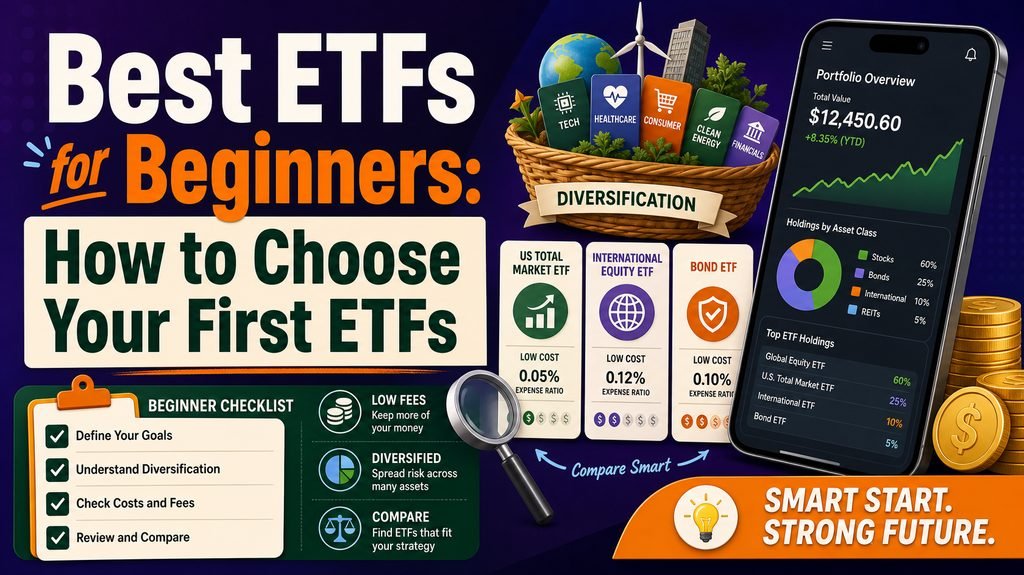
What Is an ETF?
An exchange-traded fund, commonly called an ETF, is an investment fund that holds a collection of assets, such as stocks, bonds, or other securities.
ETF shares trade on stock exchanges throughout the trading day, similar to individual stocks. When you purchase an ETF share, you own a portion of the fund rather than directly purchasing every company or security inside it.
For example, an ETF that tracks the S&P 500 provides exposure to a group of large U.S. companies through one investment.
According to the U.S. Securities and Exchange Commission (SEC), ETFs can be index-based or actively managed. Their investment strategies, costs, and risks depend on the individual fund.
Why Are ETFs Popular Among Beginner Investors?
ETFs offer several features that can make them easier to research and understand.
1. Diversification
Diversification means spreading investments across different companies, industries, or asset classes.
Instead of depending on one company’s performance, a diversified ETF may hold hundreds of securities. This can reduce the impact of poor performance from an individual company, although it cannot eliminate market risk.
2. Affordable Investment Options
Many ETFs have relatively low annual operating expenses, particularly funds that track broad market indexes.
Investors should compare expense ratios because fund costs reduce investment returns over time.
3. Easy Trading
ETF shares can generally be purchased and sold through brokerage accounts during stock market trading hours.
Their market prices may change throughout the trading day depending on market conditions and demand.
4. Different Investment Choices
ETFs provide access to several investment categories, including U.S. stocks, international companies, government bonds, and dividend-focused businesses.
This gives beginners different options to research based on their investment goals.
Types of ETFs Beginners Should Understand
Before choosing your first ETF, understand the main categories available in the U.S. market.
1. S&P 500 ETFs
S&P 500 ETFs aim to track an index representing approximately 500 leading publicly traded U.S. companies.
Popular examples include:
- VOO: Vanguard S&P 500 ETF
- IVV: iShares Core S&P 500 ETF
- SPY: SPDR S&P 500 ETF Trust
These funds provide exposure to large U.S. companies across different industries.
Beginners often research this category because it offers access to a broad group of established businesses through one fund. However, it does not represent the entire U.S. stock market.
2. Total Stock Market ETFs
Total stock market ETFs aim to provide exposure to a broader range of U.S. companies, including large-cap, mid-cap, and small-cap businesses.
Examples include:
- VTI: Vanguard Total Stock Market ETF
- ITOT: iShares Core S&P Total U.S. Stock Market ETF
- SCHB: Schwab U.S. Broad Market ETF
These funds may offer broader U.S. market exposure than ETFs focused only on large companies.
3. International Stock ETFs
International ETFs invest in companies outside the United States. Depending on their investment strategy, they may cover developed markets, emerging markets, or both.
Examples include:
- VXUS: Vanguard Total International Stock ETF
- IXUS: iShares Core MSCI Total International Stock ETF
These funds allow investors to explore international markets instead of concentrating entirely on U.S. companies.
However, international ETFs can involve currency fluctuations, political developments, and different economic conditions.
4. Bond ETFs
Bond ETFs invest in fixed-income securities, including government and corporate bonds.
Examples include:
- BND: Vanguard Total Bond Market ETF
- AGG: iShares Core U.S. Aggregate Bond ETF
Bond ETFs provide exposure to a different asset class from stocks. They may help diversify an investment portfolio, but they are not risk-free. Changes in interest rates and credit conditions can affect their prices.
5. Dividend ETFs
Dividend ETFs invest in companies selected according to dividend-related criteria.
One popular example is:
- SCHD: Schwab U.S. Dividend Equity ETF
Its investment objective is to track the Dow Jones U.S. Dividend 100 Index before fees and expenses.
Dividend ETFs may appeal to investors researching dividend-paying businesses. However, dividend payments are not guaranteed, and companies can reduce or suspend them.
6. Sector ETFs
Sector ETFs focus on specific industries, such as technology, healthcare, financial services, and energy.
They allow investors to research a particular industry without purchasing shares of every company individually.
However, sector funds can be more concentrated than broad-market ETFs. Beginners should understand their additional industry-specific risks before investing.
Popular ETFs for Beginners: Comparison Table
The following funds are examples of commonly researched U.S.-listed ETFs. They are not ranked recommendations.
| ETF | Provider | Investment Focus |
|---|---|---|
| VOO | Vanguard | S&P 500 |
| IVV | iShares | S&P 500 |
| SPY | State Street | S&P 500 |
| VTI | Vanguard | Total U.S. stock market |
| ITOT | iShares | Total U.S. stock market |
| VXUS | Vanguard | International stocks |
| IXUS | iShares | International stocks |
| BND | Vanguard | U.S. bonds |
| AGG | iShares | U.S. bonds |
| SCHD | Schwab | Dividend-focused stocks |
One important consideration is investment overlap. For example, VOO, IVV, and SPY follow the same general S&P 500 benchmark. Holding all three does not automatically provide meaningful additional diversification.
How to Choose Your First ETF: 8 Important Factors
Choosing an ETF requires more than checking its popularity or recent performance. Consider these factors before making an investment decision.
1. Understand the Investment Objective
Start by identifying what the ETF actually invests in.
Check whether it focuses on large companies, the total stock market, international securities, or bonds. Its investment objective should match the type of exposure you want to research.
2. Compare Expense Ratios
The expense ratio represents a fund’s annual operating expenses as a percentage of its average net assets.
For example, an ETF with a 0.10% expense ratio would have approximately $10 in annual operating expenses on a $10,000 investment, assuming the investment value remains unchanged.
| Expense Ratio | Approximate Annual Cost |
|---|---|
| 0.03% | $3 |
| 0.05% | $5 |
| 0.10% | $10 |
| 0.25% | $25 |
| 0.50% | $50 |
These are illustrative calculations, not guaranteed charges. Actual expenses vary with investment value.
3. Review Fund Holdings
Holdings show which companies, bonds, or other securities an ETF owns.
Check its largest positions, industry exposure, number of holdings, and concentration. A fund holding many companies may still have substantial exposure to a small number of large businesses.
4. Examine Historical Performance
Review different performance periods rather than focusing only on recent returns.
Compare the ETF with its benchmark and examine how it behaved during different market conditions.
Remember that past performance does not guarantee future results.
5. Check Assets Under Management
Assets under management (AUM) represent the total value of assets managed by the fund.
AUM can provide information about a fund’s size, but a larger ETF is not automatically better. Consider its investment strategy, costs, trading activity, and other characteristics.
6. Understand Liquidity
Liquidity refers to how easily ETF shares can be bought or sold.
Check the bid-ask spread, which is the difference between the highest price buyers are offering and the lowest price sellers are accepting.
A narrower spread generally means lower immediate trading friction, although spreads can change during market conditions.
7. Evaluate Investment Risk
Every ETF carries investment risk. Stock ETFs can decline during market downturns, while bond ETFs can lose value when interest rates or credit conditions change.
Consider your investment timeframe, financial goals, and ability to handle potential losses.
8. Read the Official Prospectus
An ETF prospectus explains its investment objective, strategy, expenses, risks, and other important information.
Review the prospectus and latest shareholder report through the fund provider’s official website before investing.
How to Start Investing in ETFs as a Beginner
Once you understand the available ETF categories, follow these basic steps to learn how the buying process works.
- Set your financial goals: Identify whether you are researching investments for retirement, long-term wealth building, or another financial objective.
- Understand your risk tolerance: Consider how much market volatility you can reasonably handle.
- Research ETF providers: Explore official fund information from Vanguard, iShares, Schwab, and State Street.
- Compare similar funds: Examine their holdings, expense ratios, investment objectives, and trading costs.
- Choose a brokerage account: Review account fees, available investments, security features, and fractional-share availability.
- Verify the ETF: Check its full name, ticker symbol, and official documentation before placing an order.
- Review periodically: Monitor whether the fund continues to match your investment goals rather than reacting to every market headline.
There is no universal minimum amount required to begin investing in ETFs. The amount depends on the share price, brokerage requirements, and whether fractional shares are available.
Common ETF Investing Mistakes Beginners Should Avoid
Understanding common mistakes can help new investors make more informed decisions.
- Chasing recent performance: Strong historical returns do not guarantee future results.
- Ignoring expenses: Expense ratios, brokerage commissions, and bid-ask spreads can affect investment costs.
- Buying overlapping ETFs: Several funds may hold many of the same companies, creating unnecessary duplication.
- Assuming ETFs are risk-free: ETF values can decline, and investors may lose money.
- Ignoring the prospectus: Always understand the fund’s holdings, strategy, and risks.
- Choosing complex funds too early: Leveraged, inverse, and highly specialized ETFs can involve additional risks and may be difficult for inexperienced investors to understand.
- Investing money needed immediately: Money required for bills, emergency expenses, and short-term obligations should not automatically be exposed to stock market fluctuations.
Are ETFs Better Than Individual Stocks?
ETFs and individual stocks serve different investment purposes.
When you purchase an individual stock, your investment depends on one company’s performance. A diversified ETF can provide exposure to multiple companies through a single fund.
For beginners who do not want to research individual businesses, ETFs may offer a simpler way to explore the stock market.
However, the right choice depends on individual financial circumstances and investment objectives. Neither option guarantees profits.
Frequently Asked Questions
Broad-market stock ETFs, S&P 500 ETFs, international ETFs, and bond ETFs are commonly researched by beginners. The appropriate category depends on individual goals and risk tolerance.
There is no universally best ETF. Beginners can research diversified index ETFs and compare their investment objectives, holdings, expenses, and risks.
ETFs can provide access to multiple investments through one fund. However, their risk depends on the underlying assets and investment strategy.
There is no fixed amount. Some brokerages support fractional shares, allowing investors to purchase a portion of an ETF instead of a whole share.
An index fund is designed to track a particular market index. It can be structured as an ETF or a mutual fund. ETF describes the fund structure and how its shares trade.
Yes. ETF prices can decline when their underlying investments lose value. Investors may lose some or potentially all of their invested money.
Some ETFs distribute income received from their underlying investments. The amount and frequency depend on the fund’s holdings and distribution policy. Payments are not guaranteed.
They are commonly researched because they provide exposure to large U.S. companies. However, they remain exposed to stock market risk and do not cover the entire U.S. market.
Final Thoughts
Choosing your first ETF is not about finding a fund that everyone should purchase. It is about understanding the available investment options and comparing them with your financial goals, risk tolerance, and investment timeframe.
Broad-market ETFs, international funds, bond ETFs, and dividend-focused funds all serve different purposes. Take time to understand their holdings, expenses, and investment strategies before making a decision.
A carefully researched investment is more valuable than following a popular ticker symbol without understanding what you own.
Official Sources and Verification
For this article, we reviewed information from official financial education resources and ETF providers, including:
- SEC – Updated Investor Bulletin: Exchange-Traded Funds
- SEC – ETF Fees and Expenses
- Vanguard – Official ETF List
- iShares – Official ETF Website
- Schwab Asset Management – ETFs
- State Street – SPDR ETFs
The fund examples and their stated investment objectives were checked against official issuer information. Readers should consult the latest prospectus and fact sheet because fund expenses, holdings, and other details can change.
Financial Disclaimer: This article is intended for general educational purposes only. It does not provide personalized financial, investment, tax, or legal advice. Investing involves risk, including the possible loss of principal. Consider your financial circumstances and consult a qualified financial professional if you need individual guidance.