

Saving money is important, but where you keep your savings can make a difference. If your money sits in an account with a low interest rate, you could be missing an opportunity to earn more without taking on the market risks associated with investing.
That is where a high-yield savings account can help.
The best high-yield savings accounts offer a way to earn interest while keeping your money available for future expenses. Still, choosing the right account involves more than finding the highest advertised rate. Fees, minimum deposit requirements, withdrawal options, and deposit insurance all deserve attention.
At NexInfoHub, we reviewed official guidance from the Federal Deposit Insurance Corporation (FDIC) and the Consumer Financial Protection Bureau (CFPB) to explain the key features readers should understand before comparing accounts. This guide focuses on practical, verifiable information rather than unconfirmed bank rates or promotional claims.
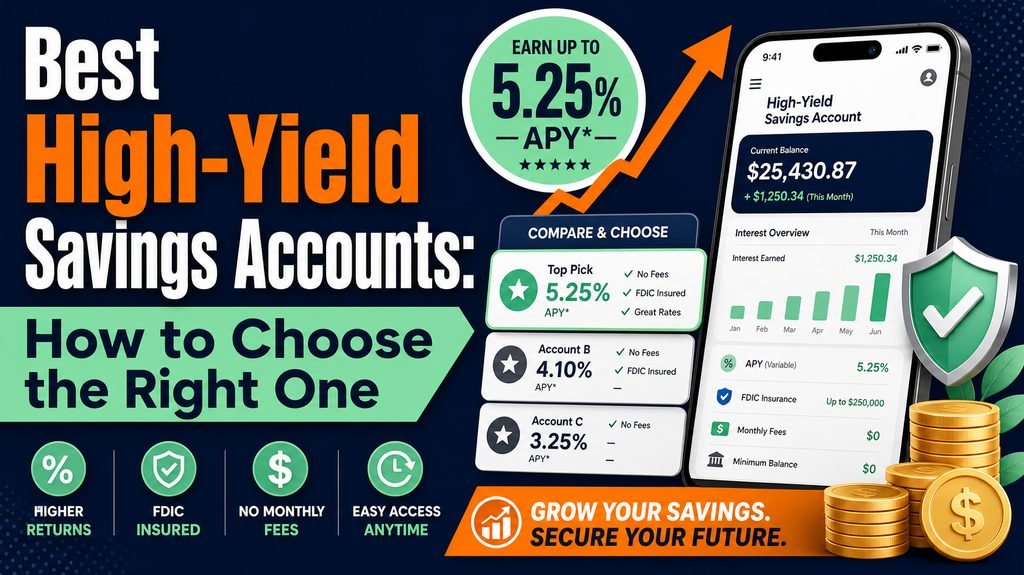
What Is a High-Yield Savings Account?
A high-yield savings account, commonly called a HYSA, is a savings account that offers a competitive interest rate compared with many other savings accounts.
Like a traditional savings account, it lets you deposit money and earn interest according to the bank’s terms. The difference is that a higher annual percentage yield (APY) can help your balance grow faster when compared with an account offering a lower APY.
Many high-yield savings accounts are offered through online banks, although options vary by financial institution.
People commonly use these accounts to save for:
- Emergency expenses
- A future car purchase
- Home-related costs
- Travel or other planned purchases
- Short-term financial goals
A high-yield savings account can be useful when you want your money to earn interest without locking it into a fixed-term product. Before opening one, review the account’s terms and make sure it suits your savings needs.
How Does a High-Yield Savings Account Work?
When you deposit money into a savings account, the bank pays interest according to the account agreement. Your earnings depend on your balance, the applicable interest rate, the length of time your money stays in the account, and any fees.
One important term to understand is annual percentage yield (APY).
APY represents the annual return on a deposit, taking compounding into account. It helps consumers compare savings products using a standardized measure of annual earnings.
For example, suppose you deposit $10,000 into an account offering a hypothetical 4% APY. If the APY stays unchanged for one year, you make no withdrawals or additional deposits, and no fees apply, you would earn approximately $400 in interest.
This is an illustration, not a current bank offer or a guaranteed return. Actual earnings depend on the account’s terms and any rate changes.
The CFPB’s Regulation DD guidance explains that financial institutions must disclose information such as APY, interest rates, minimum-balance requirements, account-opening terms, and fee schedules. You can read the official CFPB guidance when learning how to compare deposit accounts.
7 Things to Look for When Choosing the Best High-Yield Savings Account
1. Compare the APY, Not Just the Advertised Rate
APY is one of the first things to compare when researching high-yield savings accounts.
A higher APY generally means greater potential interest earnings on the same balance, assuming the account terms and other conditions are comparable. However, many savings accounts have variable rates, meaning the bank may change the rate.
Before applying, check:
- The current APY listed on the bank’s official website
- Whether the rate is promotional or ongoing
- Whether a minimum balance is required
- Whether different balances receive different rates
- Whether special eligibility conditions apply
Do not assume an advertised rate will remain available indefinitely. Compare the account’s overall terms instead of choosing solely on the basis of today’s APY.
2. Check Monthly Fees and Other Charges
Fees can reduce the interest you earn, particularly when you are starting with a smaller balance.
Some accounts have no monthly maintenance fee, while others may charge one unless you meet specific conditions. Other possible charges depend on the bank and the services you use.
Review the official fee schedule for:
- Monthly maintenance fees
- Minimum-balance fees
- Wire transfer charges
- Certain transaction or service fees
- Other account-related charges
For example, a $5 monthly fee would add up to $60 over a year. If your savings earn less than that amount in interest, the fee could outweigh your earnings.
Look for an account whose fee conditions you can comfortably meet. Never assume an account is fee-free just because its headline advertises a competitive APY.
3. Verify FDIC Insurance
Deposit insurance is an important part of choosing a savings account in the United States.
According to the FDIC, eligible deposits at FDIC-insured banks are automatically insured. The standard coverage limit is $250,000 per depositor, per insured bank, for each account ownership category, subject to applicable rules.
This means you should check both the institution and the type of financial product before depositing money.
Use the official FDIC deposit insurance guide to understand coverage. You can also use FDIC BankFind to check a bank’s insurance status.
Keep in mind that FDIC insurance covers eligible deposits against the failure of an insured bank. It does not cover every financial product offered by a bank, and it does not protect against every form of fraud or theft.
Credit unions may have coverage through the National Credit Union Administration (NCUA). Verify the applicable insurance arrangements directly before opening an account.
4. Understand Minimum Deposit and Balance Requirements
Not all savings accounts have the same opening requirements.
Some let you open an account without a minimum initial deposit. Others require you to deposit a certain amount. An account may also have separate balance conditions for earning a particular APY or avoiding a fee.
Before choosing an account, find out:
- How much money you need to open it
- Whether a minimum balance is required
- Whether the advertised APY applies to your balance
- Whether falling below a threshold triggers a fee
- Whether different balance tiers have different rates
An account with a slightly lower APY but fewer restrictions may be more practical than one with a higher rate that requires a balance you cannot maintain.
Keep enough money available for essential expenses rather than stretching your budget just to qualify for an advertised rate.
5. Review Withdrawal and Transfer Options
A savings account should help you build savings while allowing you to access your money according to the account’s terms.
Many high-yield savings accounts are managed online. Depending on the institution, you may be able to transfer money to a checking account, use a mobile app, contact customer service, or access other banking features.
Check the following before opening an account:
- Available withdrawal and transfer methods
- External bank transfer processing times
- Daily transfer limits
- Any applicable transaction fees
- ATM or branch access, if offered
Electronic transfers between banks can take time. If you are saving for emergencies, plan ahead so that you can cover urgent expenses without relying on an immediate transfer.
Always check the specific bank’s rules rather than assuming every savings account offers the same level of access.
6. Evaluate Digital Banking and Customer Service
A competitive APY matters, but so does the experience of managing your account.
A useful mobile app and reliable customer support can make it easier to monitor deposits, review transactions, and resolve account problems.
Consider whether the bank offers:
- Secure online and mobile banking
- Clear transaction records
- Account alerts
- Convenient transfer options
- Accessible customer support
- Simple procedures for reporting suspicious activity
You can also review customer feedback to identify recurring concerns about account access or transfers. Treat reviews as additional context rather than proof that every customer will have the same experience.
Choose an institution that offers the combination of service, convenience, and account features you need.
7. Read the Official Account Disclosures
Before opening an account, read the bank’s current account agreement, rate information, and fee schedule.
These documents help you understand the details that advertisements may not explain fully.
Look for the APY, interest calculation method, minimum balance requirements, fees, eligibility rules, and transfer conditions. If the bank advertises a cash bonus or promotional rate, review its qualifying conditions and duration.
The CFPB’s Regulation DD resource explains the importance of disclosures for deposit accounts, including APY, interest rates, balance requirements, and fees.
Official information is especially important because account terms can change. Verify the details directly with the institution before applying.
High-Yield Savings Account vs. Traditional Savings Account
Both account types help you save money and earn interest. The main difference is the rate and the features offered by a particular account.
| Feature | High-yield savings account | Traditional savings account |
|---|---|---|
| APY | Often competitive, but varies | Varies by bank and account |
| Fees | Depend on account terms | Depend on account terms |
| Minimum deposit | Varies | Varies |
| Access | Often online or mobile | May include branch access |
| Deposit insurance | Depends on the institution and eligibility | Depends on the institution and eligibility |
A high-yield savings account may suit someone who prioritizes interest earnings. A traditional account may be more convenient for someone who values in-person banking.
Neither is automatically the best choice for everyone. Compare actual APYs, fees, account requirements, and access options before deciding.
How Much Can You Earn With a High-Yield Savings Account?
Your potential earnings depend on your balance, APY, the time your money remains deposited, and any applicable fees.
Here is a simple illustration using a hypothetical 4% APY:
| Starting balance | Approximate interest over one year |
|---|---|
| $1,000 | $40 |
| $5,000 | $200 |
| $10,000 | $400 |
| $25,000 | $1,000 |
These figures assume the APY remains at 4% for the entire year, no deposits or withdrawals occur, and no fees apply. They are examples, not current bank rates or guaranteed earnings.
Actual interest can differ because savings rates may change and account terms vary.
The example shows why comparing APYs can be worthwhile, particularly when you have a larger balance or plan to save consistently.
Are High-Yield Savings Accounts Safe?
A high-yield savings account can be a suitable place for cash savings when it is held at an appropriately insured institution and your deposits qualify for coverage.
Verify the bank’s insurance status through official resources rather than relying only on advertisements or logos. If you hold several accounts at the same bank, review how the FDIC combines eligible deposits within each ownership category.
Online security matters, too. Use a strong, unique password, enable multifactor authentication when available, and review your account activity regularly.
Remember that deposit insurance and account security address different risks. FDIC insurance protects eligible deposits against the failure of an insured bank, not every possible loss involving fraud or unauthorized access.
Common Mistakes to Avoid
When comparing the best high-yield savings accounts, avoid these common mistakes:
- Choosing only by APY: A high advertised rate may come with conditions or change later.
- Ignoring fees: Monthly charges can reduce or eliminate the interest benefit.
- Overlooking balance requirements: Make sure you can meet the conditions for the advertised APY.
- Assuming all products are insured: Confirm that the institution and deposit product qualify for the relevant protection.
- Expecting instant transfers: Check processing times before relying on the account for urgent expenses.
- Ignoring the fine print: Promotional offers and bonus conditions may affect the account’s value.
A careful comparison can help you avoid unnecessary costs and choose an account that fits your needs.
How to Compare High-Yield Savings Accounts Before Applying
Use this checklist to evaluate your options side by side.
- Compare the current APY on each bank’s official website.
- Confirm whether the rate is promotional or variable.
- Check monthly fees and the conditions for avoiding them.
- Review opening deposit and minimum balance requirements.
- Verify FDIC or applicable NCUA insurance.
- Check transfer options, processing times, and limits.
- Review mobile banking and customer service availability.
- Read the account agreement and official fee disclosures.
- Confirm eligibility and any promotional bonus conditions.
- Choose an account that fits your savings goal and budget.
You do not need an account with the most features. You need one whose rate, costs, access, and terms work for you.
Frequently Asked Questions
The best option is an account with a competitive APY, reasonable fees, suitable balance requirements, reliable access, and appropriate deposit insurance. The right choice depends on your financial goals and preferences.
Requirements vary by account. Some have no minimum opening deposit, while others require an initial amount or a minimum balance for certain benefits. Check the official terms before applying.
Eligible savings deposits are automatically insured when held at an FDIC-insured bank, subject to applicable coverage limits and rules. Verify the institution through the FDIC’s official tools.
Yes. Many savings accounts have variable rates. Review the bank’s current APY and account terms periodically.
It depends on your needs. Savings accounts generally offer more flexible access under their terms, while certificates of deposit usually have a specified term and may impose an early withdrawal penalty. Compare the conditions before choosing.
In the United States, savings account interest is generally taxable income, subject to applicable tax rules and exceptions. Consult the IRS or a qualified tax professional for guidance on your circumstances.
Final Thoughts
The best high-yield savings accounts are not necessarily the ones with the highest advertised rates. A sensible choice considers APY, fees, minimum balances, deposit insurance, transfer access, and customer service together.
Start by deciding what you are saving for and how much you can comfortably set aside. Compare several accounts using official bank websites, review their disclosures, and verify current details before applying.
Official verification note: This article’s general guidance on deposit insurance and account disclosures was checked against official FDIC and CFPB resources. Specific bank rates, fees, eligibility requirements, and promotional offers must be verified on the relevant institution’s official website because they can change.
This article is intended for general financial education and is not individualized financial or tax advice.
1 thought on “Best High-Yield Savings Accounts: How to Choose the Right One”