
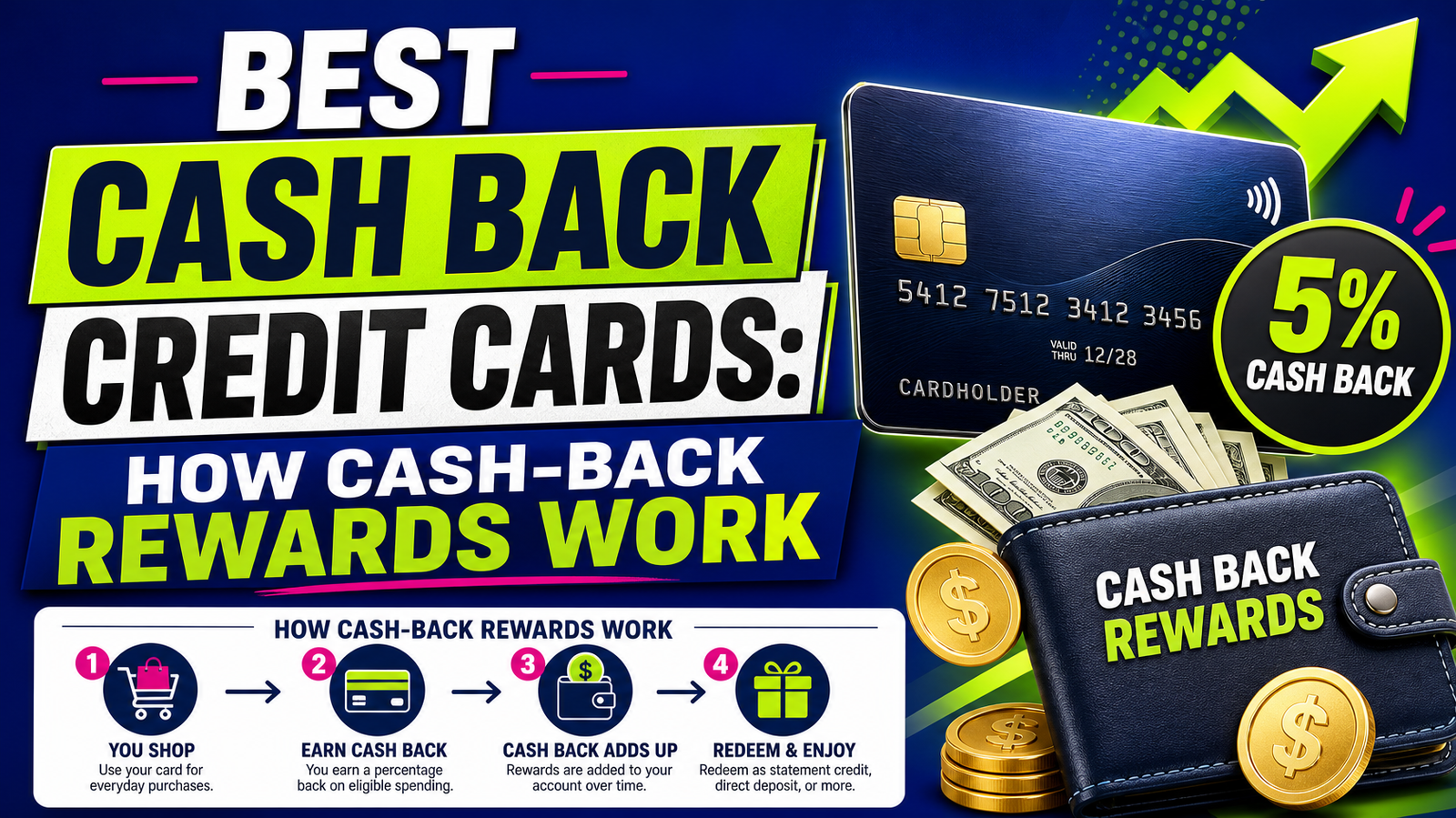
Imagine paying for groceries, filling up your car, ordering food, or shopping online and getting a portion of that money back. That is what makes cash back credit cards attractive to many consumers in the United States.
Unlike traditional credit cards that offer no purchase rewards, cash back credit cards allow eligible cardholders to earn rewards based on their spending. Depending on the card, these rewards may be redeemed as statement credits, direct deposits, checks, or other available options.
But choosing the right card is not as simple as looking for the highest advertised cash back percentage. Some cards offer higher rewards on selected purchases, while others provide a consistent rate across eligible spending. Annual fees, interest charges, spending limits, and redemption rules can also affect the actual value of your rewards.
In this guide, we explain how cash back credit cards work, compare different reward structures, explore real credit card examples from major U.S. issuers, and explain how to choose a card that fits your spending habits.
Research and verification: The information in this article has been checked against official websites and published resources from Chase, American Express, Bank of America, and the Consumer Financial Protection Bureau (CFPB). Product-specific conditions can change, so readers should confirm the latest terms directly with the card issuer before applying.

What Are Cash Back Credit Cards?
Cash back credit cards are payment cards that reward eligible purchases with a percentage of the amount spent.
For example, if a credit card offers 2% cash back on eligible purchases, spending $100 would generate $2 in rewards. Similarly, spending $500 at the same reward rate would generate $10.
These rewards are generally accumulated in an account associated with the credit card. Once available, cardholders can redeem them through the options supported by the issuer.
Most cash back credit cards follow one of three main approaches:
- Flat-rate rewards: The card offers the same cash back percentage on eligible purchases.
- Category-based rewards: Selected purchases, such as groceries or gas, earn higher rewards.
- Rotating-category rewards: Bonus categories change periodically and may require activation.
Cash back rewards can make regular spending more rewarding, but they should not be considered free money. Interest charges and other card expenses can outweigh the benefits if the account is not managed carefully.
How Do Cash Back Credit Cards Work?
Cash back credit cards work by returning a percentage of eligible purchase spending as rewards. The issuer determines the earning rate, eligible transactions, and redemption conditions.
The process usually follows these steps:
- Apply for a cash back credit card and receive approval.
- Use the card to pay for eligible purchases.
- The issuer calculates rewards based on the applicable earning rate.
- Earned rewards accumulate in your rewards account.
- Redeem available rewards using an eligible redemption method.
Example: How Much Cash Back Can You Earn?
Suppose you have a credit card that offers 2% cash back on eligible purchases.
Here is an illustration of how the rewards could add up:
| Eligible spending | Cash back rate | Rewards |
|---|---|---|
| $100 | 2% | $2 |
| $250 | 2% | $5 |
| $500 | 2% | $10 |
| $1,000 | 2% | $20 |
| $2,000 | 2% | $40 |
The calculation is straightforward:
Cash Back = Eligible Spending × Reward Rate
For example:
$500 × 0.02 = $10
These figures are examples, not a guarantee of rewards. Actual earnings depend on the card’s terms, qualifying transactions, spending limits, and applicable adjustments.
Which Purchases Qualify for Cash Back?
Many cards offer rewards on eligible everyday purchases, including groceries, gas, dining, and online shopping.
However, not every transaction necessarily qualifies. Cash advances, balance transfers, interest charges, account fees, and certain cash-equivalent transactions are commonly excluded under issuer reward agreements.
Returns and refunds can also reduce previously earned rewards.
For this reason, always review the card’s rewards agreement rather than assuming every transaction earns cash back.
Types of Cash Back Credit Cards
Understanding different cash back reward structures can help you identify which credit card best matches your regular spending.
1. Flat-Rate Cash Back Credit Cards
Flat-rate cash back credit cards offer one standard reward percentage across eligible purchases.
For example, a card offering 1.5% cash back may provide the same rate on eligible grocery, dining, transportation, and shopping purchases.
The main advantage is simplicity. You do not need to remember different spending categories or activate quarterly offers.
These cards can be a practical choice for people who want straightforward credit card rewards without regularly monitoring their spending.
Best for: Consumers who prefer simple rewards across different everyday purchases.
2. Fixed-Category Cash Back Credit Cards
Fixed-category cards offer higher rewards on selected spending categories.
Depending on the card, these categories may include:
- Grocery stores
- Gas stations
- Restaurants and dining
- Online retail purchases
- Travel-related spending
For example, someone who regularly spends money on groceries may prefer a card that offers enhanced grocery rewards.
However, merchants are generally classified according to their merchant category codes. A purchase may not qualify for bonus rewards simply because the product appears to fit a particular category.
Best for: People whose regular spending matches the card’s bonus categories.
3. Rotating-Category Cash Back Credit Cards
Rotating-category cards offer promotional reward categories that change periodically, often every quarter.
A card might feature gas stations during one period and restaurants, grocery stores, or other eligible purchases during another.
Some issuers require cardholders to activate the categories before earning the advertised bonus rate.
These cards may also have spending limits. Once the qualifying spending limit is reached, additional purchases may earn the standard reward rate.
Best for: Consumers who are comfortable checking reward calendars and keeping track of category activation and spending limits.
4. Tiered Cash Back Credit Cards
Tiered cash back cards combine multiple earning rates within one rewards program.
For example, a card may offer a higher percentage on selected purchases, a separate rate on grocery spending, and a standard rate on all other eligible purchases.
The advantage is that cardholders can potentially earn rewards across different spending categories.
However, the actual value depends on the eligible categories, spending limits, and other conditions.
Best for: People who want different reward opportunities across their regular spending.
How to Redeem Cash Back Credit Card Rewards
Earning rewards is only one part of using a cash back credit card. Understanding how to redeem them is equally important.
Different issuers provide different redemption methods.
Statement Credit
A statement credit applies eligible cash back rewards toward your credit card balance.
For example, redeeming $25 in rewards as a statement credit may reduce your outstanding balance by $25.
Keep in mind that a statement credit may not count toward your minimum payment obligation. Continue making required payments by the due date.
Direct Deposit
Some credit card issuers allow cardholders to transfer available cash rewards into an eligible bank account.
This can be convenient if you prefer receiving rewards as money rather than applying them toward your credit card balance.
Mailed Check
Certain rewards programs allow eligible customers to request a physical check.
Minimum redemption amounts and processing requirements may apply.
Gift Cards and Eligible Purchases
Some issuers allow customers to exchange rewards for participating retailer gift cards or use them toward eligible purchases.
Before choosing these options, compare their redemption value with other available methods.
For example, a gift card may not always provide the same value as a statement credit or direct deposit.
Important: Redemption methods, minimum amounts, and account requirements vary by issuer. Never assume that every cash back credit card offers all available redemption options.
Popular Cash Back Credit Card Examples in the USA
Several established financial institutions offer cash back credit cards with different reward structures. Comparing their official products can help you understand what is available in the U.S. market.
Chase Freedom Unlimited
Chase offers the Freedom Unlimited credit card, which combines rewards on everyday purchases with additional earning opportunities in selected categories.
Its official product information describes rewards on eligible purchases, including a standard earning rate and enhanced rewards in certain categories.
The card may appeal to consumers looking for a combination of everyday rewards and category-specific benefits.
Official website: https://creditcards.chase.com/cash-back-credit-cards
American Express Blue Cash Everyday
The Blue Cash Everyday Card from American Express is an example of a category-based cash back credit card.
According to American Express’s published rewards information, the card offers rewards on eligible purchases at U.S. supermarkets, U.S. gas stations, and U.S. online retail purchases, subject to annual spending limits and other conditions.
Eligible purchases outside those categories receive the applicable standard reward rate.
Its category-based structure may be worth comparing for people who regularly spend in those areas.
Official website: https://www.americanexpress.com/us/credit-cards/
Bank of America Customized Cash Rewards
Bank of America offers the Customized Cash Rewards credit card, which allows eligible cardholders to select a bonus spending category.
Its published rewards structure includes a choice of eligible categories, grocery and wholesale club rewards, and a standard rate on other eligible purchases.
Spending limits and category conditions apply, so customers should review the current rewards agreement before applying.
Official website: https://www.bankofamerica.com/credit-cards/products/cash-back-credit-card/
These examples demonstrate why comparing reward structures is more useful than choosing a card based only on its advertised percentage. Each issuer has its own eligibility requirements, fees, and redemption conditions.
What to Consider When Choosing the Best Cash Back Credit Card
The best cash back credit card is not necessarily the one offering the highest reward rate. Your regular spending, financial habits, and the card’s costs should all influence your decision.
1. Compare Cash Back Rates
Start by comparing the standard reward rate and any additional category-based rewards.
Check whether the advertised percentage applies to all eligible purchases or only selected transactions.
A card with a high promotional rate may offer less overall value if your spending does not match its eligible categories.
2. Check the Annual Fee
Some cash back credit cards have no annual fee, while others charge a yearly amount.
Consider how much you realistically expect to earn in rewards and compare it with the annual fee.
For example, earning $100 in annual rewards on a card with a $75 annual fee leaves only $25 before considering other costs.
3. Review the APR and Interest Charges
The annual percentage rate (APR) represents the cost of borrowing on a credit card.
Carrying an unpaid balance can result in interest charges that outweigh cash back rewards.
Some cards offer introductory APR promotions, but these have specific conditions and expiration dates. Always review the standard APR that applies after the promotional period.
4. Look for Spending Limits
Some cards offer higher rewards only up to a specific spending limit.
Check whether the bonus rate applies monthly, quarterly, or annually and what happens after you reach the limit.
5. Check Foreign Transaction Fees
If you make purchases internationally, review whether the card charges foreign transaction fees.
These fees can reduce the value of rewards earned on purchases made outside the United States or through certain international merchants.
6. Understand Redemption Rules
Before applying, check how you can redeem your rewards.
Look for statement credits, direct deposits, checks, and other available methods.
Also review minimum redemption amounts, account requirements, and expiration conditions.
7. Consider Eligibility Requirements
Credit card approval depends on several factors, including credit history, income, existing financial obligations, and information considered by the issuer.
No single credit score guarantees approval for every cash back credit card.
Review the issuer’s eligibility information before submitting an application.
Are Cash Back Credit Cards Worth It?
Cash back credit cards can offer useful rewards when you use them responsibly and choose a product that matches your existing spending habits.
However, rewards do not automatically translate into financial savings.
Consider this example:
Suppose you earn $30 in cash back rewards but incur $50 in purchase interest during the same period.
Your interest expense is greater than your rewards.
This is why responsible payment habits are more important than chasing higher cash back percentages.
Advantages
- Everyday purchase rewards: Eligible purchases can generate rewards.
- Flexible redemption: Some issuers offer several ways to use accumulated cash back.
- Straightforward calculations: Percentage-based rewards are generally easy to understand.
- Different card options: Consumers can compare flat-rate and category-based structures.
- Potential savings: Rewards may offset a portion of regular eligible spending.
Disadvantages
- Interest costs: Carrying a balance can reduce or eliminate the value of rewards.
- Annual fees: Some cards charge fees that reduce net benefits.
- Spending restrictions: Bonus categories may have caps and eligibility requirements.
- Redemption conditions: Some programs impose minimums and other restrictions.
- Changing terms: Issuers may change rewards programs subject to applicable agreements and laws.
How to Maximize Cash Back Rewards Responsibly
You do not need to increase your spending to make better use of cash back credit cards. A more practical approach is to earn rewards on purchases you already planned to make.
Here are some useful habits:
- Understand your spending: Review your regular expenses and identify categories where you spend the most.
- Choose a suitable reward structure: Compare flat-rate and category-based cards according to your spending patterns.
- Pay your statement balance: Paying the full statement balance by the due date can help avoid purchase interest when your account qualifies for a grace period.
- Track bonus categories: Check activation requirements and spending limits if your card offers rotating rewards.
- Review your rewards account: Monitor earned rewards, redemption options, and possible expiration conditions.
- Avoid unnecessary spending: Never purchase something simply to earn additional cash back.
A rewards card should support your existing financial habits, not encourage unnecessary purchases.
Common Mistakes to Avoid
Even an attractive rewards program can become less valuable if you overlook its conditions.
Some common mistakes include:
- Choosing a card only because of its advertised cash back percentage.
- Ignoring annual fees and interest rates.
- Forgetting to activate rotating bonus categories.
- Assuming every purchase qualifies for rewards.
- Carrying a balance just to earn cash back.
- Overlooking redemption minimums and expiration rules.
- Applying for multiple cards without comparing their costs and responsibilities.
The Consumer Financial Protection Bureau has also emphasized the importance of transparent rewards-program terms and the fair administration of earned rewards. Understanding the conditions before applying can help consumers make more informed decisions.
Frequently Asked Questions About Cash Back Credit Cards
Cash back credit cards reward eligible purchases with a percentage of the amount spent. Rewards accumulate in an account and can be redeemed through the methods offered by the issuer.
The best option depends on your spending habits. Flat-rate cards may be easier to manage, while category-based cards can offer higher rewards on selected eligible purchases.
Some issuers allow direct deposits or mailed checks. Others provide statement credits, gift cards, or eligible purchase redemptions.
Some have no annual fee, while others charge a yearly amount. Compare the fee with your expected annual rewards before applying.
Expiration rules vary by issuer. Some programs allow rewards to remain available while the account is open and in good standing, while others have expiration or inactivity conditions.
Cash back rewards themselves do not improve your credit score. However, responsible credit card use and on-time payments may help establish a positive credit history when the issuer reports account activity to the credit bureaus.
No. Only eligible transactions earn rewards. Cash advances, balance transfers, fees, and certain other transactions are commonly excluded under card agreements.
Neither is universally better. Cash back cards offer relatively straightforward rewards, while travel cards focus on points, miles, or travel-related benefits. The better option depends on your preferences and spending habits.
Final Thoughts
The best cash back credit cards can make everyday purchases more rewarding, but their actual value depends on how you use them.
Before choosing a card, compare its reward rates, annual fees, APR, spending limits, redemption options, and eligibility requirements. A flat-rate card may suit someone who prefers simplicity, while a category-based card may offer more value to someone whose regular spending matches its bonus categories.
Most importantly, do not spend more just to earn rewards. Pay your bills responsibly, understand the card agreement, and choose a rewards program that fits your financial habits.
A well-chosen cash back credit card can provide useful benefits without making your everyday financial decisions unnecessarily complicated.
Editorial disclosure: This article is intended for general financial education and is not individualized financial advice. Product features and rewards terms may change. Readers should consult the latest official issuer disclosures and cardmember agreements before making financial decisions.